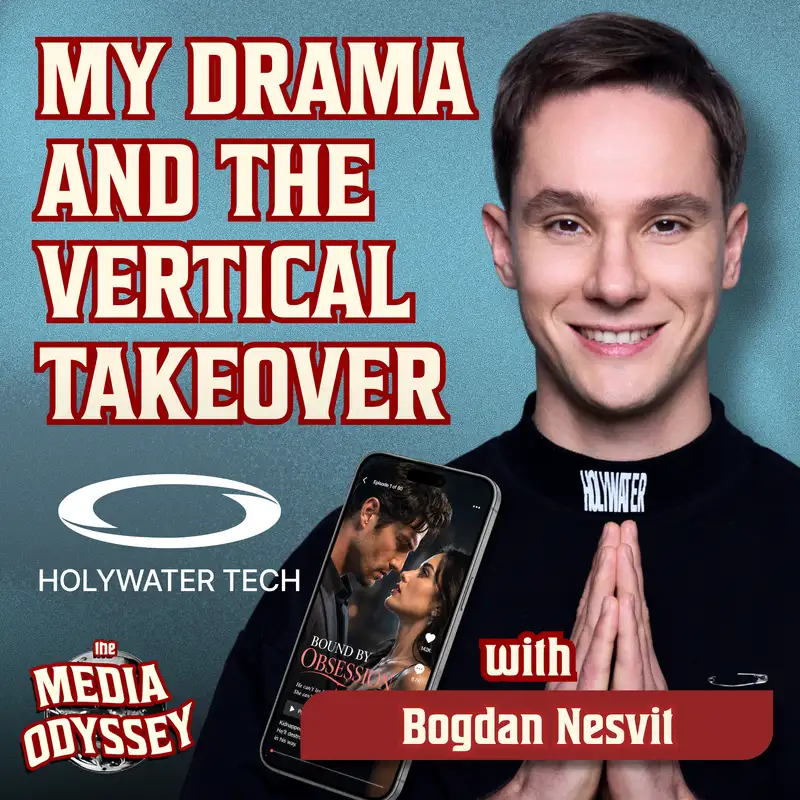
MY DRAMA AND THE VERTICAL TAKEOVER
Download MP3Evan Shapiro: [00:00:00] Welcome to the Media Odyssey Podcast. Live at Stream TV Europe. That is Marion Ranchet.
Marion Ranchet: And that is Evan Shapiro.
Evan Shapiro: Thank you all so much for coming to Stream TV Europe. The first one. Anybody here listen to our podcast? Raise your hand, give a cheer. We are recording this. So the energy here has been amazing.
Day two is just starting. Thank you all for rising early after our great party last night. We have, are you having a good time, Marion?
Marion Ranchet: I'm having a good time. Yeah.
Evan Shapiro: You crushed it yesterday. We have an amazing guest here. We're gonna break down the mystery around microdramas. Bogdan Nesbit is the founder of HOLYWATER TECH and My Drama.[00:01:00]
And we're gonna walk you through our mutual skepticisms around micro drama and we're gonna get inside the business model. Bogdan has graciously volunteered to represent this massive movement in the content ecosystem right now. Bogdan, could you just tell us how, I think everybody in media or most of the mainstream media folks believe that the microdrama phenomenon just popped outta nowhere, in the last 18 months.
But you founded this company a while ago, and it didn't start in video, it started in a different art form. So walk us through the origin story of Holywater and My Drama. Oh, yeah, sorry. You need your clicker.
Bogdan Nesvit: Thanks a lot Evan for inviting. Thank you for coming guys. So HOLYWATER TECH has existed for six years.
I founded the company with my current co-founder. We started from Interactive Stories platform. We started building those interactive books where you can make choices and [00:02:00] those choices lead users to different endings and different chapters. Then we started asking us ourselves a question, how can we scale those interactive stories?
And for me, the obvious answer was to launch a books platform for amateur writers around the world, basically to source great books, assess them with data, and turn the best books into interactive stories. That was our second product that we launched. Then we started thinking about how we can develop it further.
So this, we launched audio books based on the books. And then in 2024, we launched our first video streaming platform, microdrama platform called My Drama and that is our biggest product right now.
And now we are also focused on developing AI video streaming. I'll be talking about this in the future.
This is how our content journey and user journey looks like. So the first thing that you see is our books platform. It's called My Passion. We have more than 1 million monthly users, and we test our books on My Passion. So we create hundreds of books per year. We test them on real data, [00:03:00] so we get real data from users.
Then the best books we turn into AI generated video series. So the second step, it's 100% AI generated video series. We have a different platform for that. So we do test AI generated video series to see what kind of characters perform, what kind of hooks and cliff hangers perform. And then the best AI generated video series we go and turn into live action mobile first vertical, movies for My Drama.
This is actually the real case. Started from a book and we turned it into video series. And then the next step that we are aspiring to, so basically our vertical video series, they're getting tens of millions unique users and mostly in the United States.
And there is a huge fund base around our best movies. And then the logical step would be why not go full screen and actually turn this into a movie? And this is something that we are working on.
Marion Ranchet: That's quite funny actually, that you, this, you are going full circle on this. Everyone is very keen and is looking at you because you went vertical.[00:04:00]
And you wanna go again to the big screen, long form, fascinating. But let's go back a bit on My Drama. 'cause how did you build this from scratch. So My Passion, you worked on books, then went to the video. How did My Drama really come to be and how did you build it to be, how many people are we talking about, using that platform?
Bogdan Nesvit: Right now we have close to 7 million monthly active users on My Drama. It's, mostly users in the United States. So the, basically the question for us was, when we had the books platform, the question was how do we expand our reach, reach our point of our content. And the plans that we had was either to launch comic book books platform, basically to turn books into comic books or to go video streaming.
Video streaming was more risky for us because we didn't have any expertise in films creation. But it was also more ambitious bet and it was something that I'm super passionate about. I'm passionate [00:05:00] about movies, so we decided to go ahead.
We basically started turning our best books into video series. We found great studios. We worked with those studios to create, data-driven scripts based on our books, and they started working really well. So we started scaling it further, and now we are working with a lot of studios, including Fox Entertainment and other studios in the US.
Evan Shapiro: And, how many different movies?
So you take these movies, you break them into micro episodes, right? About three minutes long on average?
Bogdan Nesvit: It's about one minute long, actually.
Evan Shapiro: One minute. Yeah. Okay. And so how many different movies titles do you have on the platform right now?
Bogdan Nesvit: Right now it's close to 300 already on the platform. They are gonna be close to 500 by the end of the year, and, probably 1000 by the end of the next year.
Evan Shapiro: The average number of episodes, micro-episodes within each film is what?
Bogdan Nesvit: Up to 90 episodes. It's like, a whole movie of one and a half hours to two hours. It's just, it's breaking down, broken down into those small bits to tailor to current consumption [00:06:00] habits of small engage episodes which start with the hook and end with the cliffhanger.
Marion Ranchet: How many, so you said the US was your main market, right? Did you do that on purpose or did you launch globally and then the US picked it up?
Bogdan Nesvit: the US will has been always our main market, since our interactive stories era, it is the biggest market. So we consciously launched in the United States.
Marion Ranchet: And so how are people paying you? What's the model, right? Because that's, one of the thing, I, like the idea of vertical video a lot. You, call it Pocket TV, Evan. I maybe do not understand the business model of a lot of those apps, this is where, yeah, I'm getting doubtful about the model.
Bogdan Nesvit: Yeah. The model has actually evolved a lot since the beginning. It all started from, what is called micro transactions. Imagine that you basically watch a 90, 90 episode series, and you pay for each series with coin. [00:07:00] You have some number of coins that we give you as the app.
Once you run out of coins, you have to top up, you top up by buying in our purchases. At that time when we had 10 series, that was the only monetization we could afford ourselves because otherwise we wouldn't be able to return the investment. So it was the first step that we did. Now we fully transition to subscription.
So basically our viewers subscribe in order to watch all the library without any limits. And now we are currently transitioning, I really believe in ads monetization and brand integration. So now we are transitioning into this monetization as well to tailor to broader audience, which is not ready to pay for subscription.
Evan Shapiro: And you have a kind of multifaceted subscription model. So the subscriptions range from a week to a month to a year. And you are almost at the end of your transition away from micro payments, right? How much, what percentage are subscribers of your users now?
Bogdan Nesvit: It's 90 plus percent right now.
Regarding different tier, different types of subscriptions. So [00:08:00] basically we have data driven, company. We have like petabytes of user data and we use it to customize user experience and we run about 1000 A/B tests per year, even more than that. So we are testing different prices, different subscription lengths, and we basically tailor our prices and lengths to different audience segments.
Marion Ranchet: How about your competitors? Because are they moving away from micropayments to subscription too? Is that something that everyone is seeing?
Bogdan Nesvit: I think you cannot go against evolution. If you go against evolution, you just become dinosaur. The evolution right now is moving towards subscription, and I can see that more and more competitors are starting to basically go into subscription as well.
It's just the nature of flow of the world right now, and I'm sure that most of them will either transition or they will just stop existing because the transactional model, I don't think that it'll be relevant anytime soon.
Marion Ranchet: But do you think you're gonna make as much money? Because a lot of what [00:09:00] we've heard these last few years was very focused on, ooh, this is the new thing.
You are gonna make a lot of money because essentially people are being pushed to consume and consume. And so moving to subscription, do you think you can make up for the money that you guys were making on micropayments, do you think it's sustainable?
Bogdan Nesvit: This is super valid challenge. So I was asking myself this question as well, but the data shows right now a different story.
I believe that we are gonna, we are gonna make more money from subscription because subscription has much higher retention revenue. So basically the retention of our audience is about two times higher with subscription versus in-app purchases. This means that we are retaining people who are continuing to watch and to pay.
And at the same time, the data shows us right now that users with subscription, they consume three times more content than users with in our purchases. So it's all about retention revenue. We are also running tests with monetization. For monetization, the metrics are even higher. Retention is even higher, and [00:10:00] the daily consumption is like one and a half hours.
You can imagine.
Evan Shapiro: With that?
Bogdan Nesvit: With monetization, people consume one and a half hours per day of content.
Evan Shapiro: The acquisition model. How do you acquire customers? What is the because I did an article about ReelShort, which is one of the biggest, if not the biggest of the players in the micro drama space.
And what I showed was that for every dollar they brought in in revenue, they had to spend in marketing, so that they were basically losing money on every subscriber or acquisition. What are you finding? How are you acquiring customers? What's been most effective? And what, what is the cac?
Is it something that you can manage to get down over time?
Bogdan Nesvit: I'll, start from afar if you don't mind. Can you please raise a hand who knows who this is, what this is. This is basically the strategy poster drawn by Walter Disney. This is the whole strategy of Disney that he drew [00:11:00] in 1950, something like that.
And it basically shows that in the center of every content company is IP. IP is the main value of the company. And then he shows how this IP is being repurposed and recycled in different forms. Like for example, you create a movie, then you have music track out of this movie, then you create a comic book and stuff like that.
And also he shows different types of distributions like TV, theater, and other places. So right now, the world has evolved a lot. The world has evolved, and what we are doing, we are basically adapting a Disney strategy to the current consumption habits, to the current distribution habits, to the current content creation ways.
So basically, our main distribution right now is social media. This is where most of the, especially young audience, spends their time. And what we do it in two ways. We have organic social distribution, and we have paid marketing social distribution. So we organically, we publish pieces and parts of our content via Facebook, [00:12:00] Instagram. We generate about 2 billion monthly impressions to reach out to our audience, and then we drive audience to our platform.
The second way we do distribution is paid marketing. So basically we are running super targeted ads for particular user segments across Facebook, Snapchat, TikTok, and we generate a lot of impressions by running ads.
Like at any given month, we are running around 30, 30,000 unique video creatives, video ads that we create tailored to particular user segment based on our data. Right now, 70% of our users come from paid user acquisition and 30% comes from organic, marketing. What you said about ReelShort, that they spend dollar and they return dollar, and they return dollar. I'm not sure about the economics because I don't know it. I can tell you that for us, the economics is much more different. They're returning money. We are actually profitable right now even though we are spending a lot on marketing and we are growing more than two times year on year.
So [00:13:00] there is economics definitely there, but I don't think that if someone relies 100% on paid marketing, they will be able to survive within one to two years because paid marketing tends to, the price tends to go up every year, especially once the competition grows. The companies have to start thinking about other alternative acquisition channels as well.
Marion Ranchet: Talking about organic, because people here in different ways are doing the same thing as in pushing content on social and trying to bring people back to their own and operated. So it is only 30% of the users. But so have you, how have you managed to do that, to bring those people?
Evan Shapiro: For the organic customers?
Marion Ranchet: Yeah, for the organic portion of it.
Bogdan Nesvit: So the main thing is to, basically we build this complex strategy. We have for, we have hundreds of pages on Facebook, for example.
We have a lot of accounts that [00:14:00] there are companies, a couple of companies that do really efficiently social distributions. We have a lot of YouTube channels and what we do, essentially, we test different clips, based on data, we test different clips. They all end on the cliffhanger, meaning that our viewers want to continue watching and understand what, what's going on there.
And the only way to find out is to go to our platform and to watch it on our platform.
Evan Shapiro: So you're giving away a decent amount of content for free. It's like selling drugs here, take a taste and come in and,
Bogdan Nesvit: It's more like a product preview you basically watch for,
Evan Shapiro: So it's not like selling
Bogdan Nesvit: Yeah.
Evan Shapiro: It's just like a drug dealer. Try it a little bit.
Bogdan Nesvit: I believe that drug dealers use this strategy of product preview. I think car dealers, use this strategy as well. And a lot of other companies, so basically users watch about 20 minutes. They decide whether the, their time investment is worth the emotion that they will potentially get from this content and then they go [00:15:00] to the platform and watch it.
Evan Shapiro: And when you said you have all these different YouTube channels and Facebook pages. Are they based on different titles or is it Holywater, My Drama. What, how are you running several different Facebook pages differently?
Bogdan Nesvit: We are testing in different strategies right now. The one, that you mentioned is super interesting that we are running tests for, basically each page is dedicated to each particular movie and we are trying to build a fun base around this movie.
Evan Shapiro: I think, one of the things that, one of the theories I have about this current moment and what's gonna happen moving forward is that the AB testing, being a great AB tester, being a test and learner is paramount, it's central to the, to success. Is that your experience?
Bogdan Nesvit: I think one of the main advantages that we will be able to build as media content, and any entertainment companies is, data set that we have, basically user data that we already have and how we leverage these data.
I don't think that in AI error, product [00:16:00] will be a big competitive advantage. You can build almost any product with Claude right now. We are already building products with, without writing any code. We didn't do it last year, we're already doing this right now. So the advantage will be data that you have for your users and how you use, utilize that data.
So A/B tests are basically paramount for us. It's slicing our existing data that we have and seeing what kind of slice works the best and working with the slice with customized and personalized approach.
Marion Ranchet: So let's talk money a bit. How big is this business? Because we've been seeing a lot of numbers, but at the same time, most of those companies, your company is six years old. We, and none of them are public as far as I know. We're seeing estimates.
What are your own estimates from what you've seen? What is something realistic in terms of what this business can bring? And number two, we tend to box you guys in that microdrama hype, [00:17:00] but from what I'm hearing, you are changing your model in a dramatic way.
So do you want to still be in that box in, a year?
Bogdan Nesvit: In terms of the numbers right now, what we know and what kind of things we're estimating right now, the market is around, is around $11, $12 billion right now. The total market in the world, including China. China is the biggest market because it started about six years ago actually.
And outside of China, it's much smaller. By 2030 I think the market is, is projected to be around 25 billion, something like that. And it's gonna be 10 billion outside of China, mostly in the United States. So the market is huge. The market is growing and the potential is also huge.
So we are betting that this market is gonna be huge, but also the volume of this market will actually depend on whether companies like ours will be able [00:18:00] to push this format further, push this format further beyond microdrama, because microdrama, what is micro drama in terms of content? Like content? if I speak about content, microdrama is five tropes. It's five different tropes, recycled in different settings, recycled in different settings.
This is what they invented in China. And right now it's still a niche phenomenon. It's not mainstream media. Still niche phenomenon in order to turn this into mainstream, we'll have to experiment with new things. We'll have to experiment with new generals like fantasy, thriller, detective sports and everything else. So this is what we are doing right now. It takes investment because it doesn't work from the first time as well as those five tropes that are already proven by data, but I'm sure that, we'll find a way and, the market is gonna be huge.
Evan Shapiro: Yeah. So basically anything that has an innate cliffhanger in it will probably work in this. So detective stories, true crime, thrillers, things like that. Sports, again. Yeah. So let's talk about the content [00:19:00] itself, but also you mentioned AI. How involved is AI in. How much do you spend per movie, if you can share that, and then how much of that is affected by the use of AI?
Bogdan Nesvit: So about two years ago, I started asking myself and my team a question, like how can we translate our 1000 books library to 50 languages? And the only answer was with AI. So we started translating our books with AI and they started performing really well. We scaled down our books platform two times.
Thanks to that. Now, the next question was, how can we create a book 10 times faster than we used to create them? So we created an internal AI tool that helps the writers to create books faster. Now we create tens of even hundreds more books than we used to create. Then the next question was, can we generate a movie with AI? So that movie actually works.
And we [00:20:00] started generating movies, and those movies actually started to work really well, not just. in terms of giving us data for life action movies, but also as a standalone platform. Our AI generated series right now is the fastest growing product that we have, and we also built an internal tool for basically movies generation.
So we have real directors who generate movies with AI internally using our tools. This is just for the comparison, like in terms of how long would it take to produce a movie if we decide to produce a movie right now? Like for Netflix is gonna be 100 weeks.
For My Drama, this is our life action platform is gonna be four months, four months for right now in the world, it's like super long timeline. In four months, everything can change in the world, a lot of wars can be started. The consumption habits can change and stuff like that. And with AI we can generate the movie in two weeks and get real data in two weeks and basically scale.
In terms of money, you, asked about that, so for live action movies, we would spend from 120,000 to [00:21:00] 250,000 depending on the quality, depending on what kind of talent we are using, depending on the location and other factors. For AI generated movies, it's a couple of thousand dollars,
Evan Shapiro: But, so first of all, the name of your AI production engine is MyMuse, right?
Bogdan Nesvit: MyMuse, yes.
Evan Shapiro: And you talked about AI being involved in the production, getting it down to two weeks and a couple thousand dollars in production value, but you're still using human script writers and human directors in every piece, right?
Bogdan Nesvit: Yes, all the scripts are written by humans, and this is something that we haven't been able to optimize with AI.
I don't think that we'll be able to do that anytime soon. When I'm thinking about scripts and content ideas. I'm thinking about this quote by Nvidia's founder. Nvidia is one of the largest companies right now, AI companies in the world. He said an interesting thing when he was [00:22:00] asked like, what kind of skills should humans create to be, able to compete with AI?
And he said that, I don't, he doesn't think that he can compete with AI in efficiency in other things. But what he said as well is that suffering and emotions are things that make humans unique. Basically, suffering and emotions. Suffering and emotions make humans a character. And a character is something that AI doesn't have.
So I believe that in order to create a genius, great script that is gonna reach like tens of hundreds of millions people, you have to have some emotion. You have to live through it. You, and this is what humans do the best right now. So all the scripts are written by humans. I've tried with my co-founder to write scripts with AI myself, and we just started My Drama.
It didn't work like it was, the metrics were insane. So we have professional script writers who are using scripts, using their emotions and view of the world.
Marion Ranchet: You are creating different platforms every time, right? So My Passion, My Drama, My [00:23:00] Muse. Are you thinking about having some sort of a super app at some point?
What, why are you breaking down things like that. Is it because you think that specific segments, et cetera, need to be served within a certain app?
Bogdan Nesvit: There are a couple of questions in the business that I keep coming back to. That's one of them. I've been doing this, like I've been coming back to this question for at least four years.
And for now, we've decided that separating the platforms would be the best solution because we are separating the audiences as well. It's easier to manage data audiences within each product. Also, you can sell subscription for each product within each app. So for now, that's our strategy. But, We'll see in the future. We are having thoughts to unify this into one super app, mobile-first entertainment platform with comic books, anime, movies, books, interactive stories, audiobooks and everything else.
Marion Ranchet: So you started a few years ago and AI is [00:24:00] now more present than ever. And are you, do you have data and do you see differences in terms of engagement and relatability depending on how much AI was involved in your process or not?
Bogdan Nesvit: I'll share an interesting slide. This is the real usage data from our platforms. What you see here is episodes retention. So basically each share, like if 100% of people started the show then, 100 people started the show, then, by the end of, I think one and a half hours, I don't see it from here, but it's gonna be nine 91%, 91 people remained.
So for My Drama Life action movie, it's inside the columns. This is what we, the data that we have for MyMuse, the AI generated movies, you can see that the data is pretty much similar in terms of user retention within episodes. The main difference between AI generated movies. Movies and life action movies.
What we see right now is not conversion into payment, it's not [00:25:00] retention. It's about how far we can scale this movie. So it seems right now that the audience that is ready to consume AI generated content is much more limited than audience that is ready to consume live action content. So we are able to scale our live action movies much more efficiently than AI movies.
In order to sustain the same volumes for AI platform, we have to produce much more content then for live action.
Evan Shapiro: And do you wanna show a clip of the AI production right now?
My Drama: You poor thing. Let me see what happened to you.
Let's begin.
No. Please no.[00:26:00]
So hello my holy sacrifice.
It can't be.
Evan Shapiro: So what you're saying is the consumer basically susses out AI versus live action and is choosing live action, choosing to watch the live action movies more than they are the AI generated stuff.
Bogdan Nesvit: It's more, it's yes, consumer by making a choice, consumers basically either limit our scale or, promote our scale on the social platforms.
And what we see is they, more people are choosing life action right now. Yes. On social platforms.
Evan Shapiro: And moving into these other genres, you says it's expensive, it takes investment. Is that the rationale behind the partnership with Fox?
Bogdan Nesvit: It's one of the rationales, yes. Because we want to push this forward and turn microdrama into mainstream entertainment like pocket TV, [00:27:00] mobile TV, whatever you call it.
And, Fox, and Fox Entertainment, wants to learn from our data and they also want to be where the audience is. And the audience is on social media. So we basically combined those two motivations and created a synergy together. And right now together with Fox, we are producing different genre. We are using talent as well in our shows. And, let's see where it goes.
But the data that we are already getting from Fox Produce shows is really great. And there are some hits that we produced together already.
Evan Shapiro: But there's another aspect of the Fox partnership, around ad sales as well, correct?
Bogdan Nesvit: Around?
Evan Shapiro: Ad sales, advertising sales.
Bogdan Nesvit: Yeah. Yeah. One of the things that we really believe into is monetization because it'll help to expand the space and to turn it into actually mainstream. And Fox has really great expertise in ad sales. So that's one of the things that we are exploring. Yes.
Evan Shapiro: So it's not necessary for you to necessarily build a huge enterprise around advertising in house, you're gonna partner with [00:28:00] them and let them carry a lot of that weight.
Bogdan Nesvit: True, and we are gonna focus on what we do the best. What we do the best is using data, and doing social distribution and generating content with AI as well.
Evan Shapiro: Yesterday I talked about how the fact that a lot of these conferences turn into group therapy, and you, a couple years ago, really, you got burned out and you came to a crisis point and you really changed your life. And the philosophy of the culture at the company around mindfulness, that was, our first conversation over dinner.
Can you talk a little bit about that? Why, how did you come to that and what does that look like for you?
Bogdan Nesvit: Yeah. I've been meditating for more than 10 years. Meditation right now is the most important part of my life and my day. I meditate for about two to three hours per day, every day. I never skip. [00:29:00]
And, it wasn't about the crisis that you told me about. First of all, it started as I have ADHD, like I have super intense ADHD. It's hard for me to focus and consciously direct my focus somewhere. So I started meditation is basically the tool to help me to focus. And it, worked a lot. It helped me a lot. And I believe that we, become what we focus on. We become what we focus on. We can become anything if we can consciously direct our focus somewhere. And what we see right now is that most of the people, they don't train focus.
Most of the people, they don't even own their focus. Our focus gets hijacked by social media companies, by companies like our, like I'm building. Companies that want to turn us into consumers and stuff like that. And we go and work out in the gym, right? We go do cardio. I think most of the people here do cardio and take care of their body, but most of us, we don't take care of our focus and our of our mind, which is, which is [00:30:00] much more important I think than the body.
So meditation first of all, became the tool to improve my focus. It improved it significantly. Then I started seeing other benefits. Then I started seeing a lot of narratives that have been, that used to be going on through my head that I never noticed before.
I realized that most of us are actually NPCs, those non-player characters in games who are run by a couple of narratives, like couple of narratives created for them. And I realized that it was me. I was running on the character narrative that I had to achieve something because as a kid I got praise as an achiever.
So that was constantly running through my head. And I didn't even notice it. I thought I was like a conscious human being. And then I started seeing it from afar, like this narrative running through my head. This narrative. And what meditation gave me is basically this pace between this narrative running in my head and my conscious ability to choose whether I will choose this narrative and will react to it.
So the, that was [00:31:00] the second thing that, the second progression with meditation that I got. And the third one that I'm going through right now is basically meditation also helped me to find answers that I couldn't find. I think the two questions that I couldn't find answers throughout my life, like who we are, why we are here in this 3D matrix and meditation was the tool that helped me to find these answers and, yeah.
I've never been happier in my life and, if I were to, I don't give advice, I don't believe in advice because we are going through our own journey, each of us, but if I were to say something which would be the most impactful for this world that I see it right now, I would say is if everyone meditated for 30 minutes to 60 minutes a day, I think we would have less worries, we would be much more happy. We would be able to direct our focus wherever we want and while by directing our focus to any place that we want, we can become anything that we want.
So [00:32:00] that's the journey with meditation in a couple words.
Evan Shapiro: Amazing. and obviously it seems to be working for you. You're an impressive person and I think, it sounds like you have a real design for the future of this app. It's not microdramas, it's a programming entity. So thank you so much for joining us on the podcast.
Marion Ranchet: Thank you.
Evan Shapiro: That is Marion Ranchet,
Marion Ranchet: and that is Evan Shapiro.
Evan Shapiro: Thank you for watching the Media Odyssey podcast. We'll see you next time. Thank you.
Creators and Guests