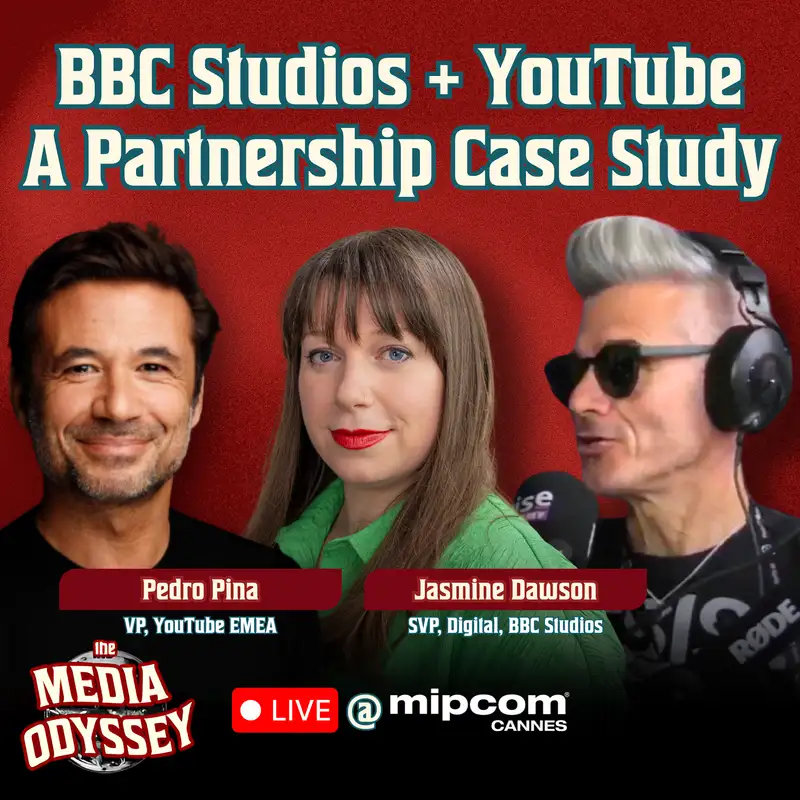
BBC STUDIOS + YOUTUBE A PARTNERSHIP CASE STUDY
Download MP3Lucy Smith: [00:00:00] Good morning. Welcome. We are so excited to see so many people here today. Warm welcome to MIPCOM Cannes and to this opening keynote session that really goes to the heart of our mission at MIPCOM Cannes this year, which is really helping bridge the gap to find new partnerships and opportunities between the creator economy and mainstream media.
It's a subject we'll be revisiting with some of the world's biggest creators, platforms, producers, broadcasters, and distributors on this and other stages across the market over the coming days. Now, this year sees YouTube's first major presence at MIPCOM in this 20th anniversary year, and we are absolutely thrilled to welcome them to the show.
They're in Cannes with a clear aim to foster further collaborations and find shared successes with the global TV industry, be that by helping partners expand reach, deepen audience [00:01:00] engagement, or unlock new modern monetization opportunities. In their words, we succeed only when our partners do.
So this session explores the strategy behind one such partnership with BBC studios. So sharing their approach and findings will be YouTube's vice president of EMEA, Pedro Pina. With BBC studios, senior Vice President, digital Jasmine Dawson, and moderating proceedings will be media cartographer and MIPCOM stage regular, Evan Shapiro. Please join me in welcoming them to the stage.
Evan Shapiro: Hi everybody. Welcome to MIPCOM 2025. Thank you guys for joining me [00:02:00] here. As Lucy said, I think MIPCOM this year has gone through a pretty sizable shift, and the two of you are, I think, representative of that change. MIPCOM I think has become this year the crossroads, as Lucy said, between mainstream media And the creator economy.
And today we're gonna have a conversation with two people from each side of that equation. But I think it's also a case study in how collaboration between YouTube and a major provider of content can work. Before we get into the conversation, let's take a look at the results of how that collaboration works.
Pedro, this is your first MIPCOM, right?
Pedro Pina: Yeah, it is my first,
Evan Shapiro: Not just YouTube's first major presence here. It's your first visit to [00:03:00] MIPCOM.
Pedro Pina: Yeah, so I've been in Cannes for a long time. Thank you, whomever is clapping. It's like I have one fan. The yeah, we've been coming to Cannes for Lion for the biggest advertising festival in the world, but first time we're in Cannes for a content conversation.
So we're excited about being here.
Evan Shapiro: And and Jasmine, you've been to MIPCOM before, but this is a new position for the Digital Enterprises division of BBC studios here as well. Is that a fair assessment?
Jasmine Dawson: Yeah, that's definitely fair. I've been with BBC studios seven years. I've been at MIPCOM a couple of times, but this is definitely a new way of looking at things for us.
Evan Shapiro: So I think this collaboration in particular, I wanna debunk something. YouTube is not here to buy content, correct?
Pedro Pina: No, it's not.
Evan Shapiro: And so just get that outta your head.
Pedro Pina: 30% of people start leaving the room.
Evan Shapiro: Right. I, hopefully you're entertaining enough to keep them around. But I think what this collaboration personifies is this new theory, and I wanna run this by you, which is MIPCOM is this market where people come to buy and sell television and they used to [00:04:00] come up with a business model For an individual piece of IP where I put together a coalition of funders and I distribute my content all over the world. And I think there is some lament in the market that there are fewer buyers than there used to be, consolidation. And that the commissioners are not commissioning what they used to be at the same rate that they were. And these are the major challenges here.
This is a case study on how there is a new class of buyer in the marketplace. And that class of buyer is the consumer themselves. It isn't a gatekeeper or a commissioner. It's going directly, building a direct to consumer business out of a major studio or production company business and using the gateways and the roadways of the creator economy to get to them.
So that is the theory I think this represents, and I think this market is about mainstream media, finding that new buyer class, that consumer, that they can speak directly to.
You are the head of that for one of the most traditional media companies on the face of the [00:05:00] earth. How does that theory sound to you as a kind of person who has to find those audiences?
How does that differ for BBC studios in this market this year?
Jasmine Dawson: I think it's a big seismic shift for some and I think an aha moment for some. For us, it's something that we've been doing for years, so for us, putting our Audience obsession at the heart of everything we do is what makes our business work now.
Being fandom first and like for us, BBC studios is proud to build the biggest fandoms across the world. And we know That we have to be able to do that where the audience are obsessed about being and for us, that's why the partnership with YouTube is so critical, because that partnership is enabling and driving that creative first mindset.
Evan Shapiro: We'll talk about that a bit. We're talking about one of the great franchises in television history here, planet Earth. And you've really used that to find new audiences and new revenues for the studio. Can you just crack that open [00:06:00] a little bit?
Jasmine Dawson: Yeah. BBC Earth is one of our longest standing YouTube channels. An additional brand in its own right, but it very much started its home as a YouTube channel and bringing all of our amazing content from the natural history unit at BBC studios together. So we've got Planet Earth, we've got Blue Planet, we've got some amazing new titles coming out from walking with Dinosaurs to Mammals. There's so many things on there.
It has got a rich history, but what we are excelling at is finding our fandoms across the world who care about this, who are finding their place to be able to engage with the content they love and the content that resonates with us. For us, that's not just about finding the fandoms where they live, but also understanding we can monetize those audiences both on platform and off platform.
So thinking about e-commerce for us is a really interesting opportunity because BBC Earth stands for everything that goes wrong with saving our planet Earth. And [00:07:00] sustainability is a strong thread of that. We want to be able to be at the forefront and therefore that whole ecosystem for us.
So whether it's our FAST channel and BBC Earth, our YouTube channel or e-commerce, we are really looking at fandom driving that entire commercial ecosystem.
Evan Shapiro: And going back to the more traditional end of the business, you're also selling that show to major platforms.
Jasmine Dawson: Yep.
Evan Shapiro: It's probably doing as well as a licensed product as it's ever done.
Correct?
Jasmine Dawson: Yep.
Evan Shapiro: And the viewership. This is what I think most people don't understand the viewership of the primary show. The documentaries is going up across platforms as the fandom grows on YouTube and other platforms. Is that correct?
Jasmine Dawson: That is correct.
Evan Shapiro: So defying television gravity to a certain extent.
Jasmine Dawson: Yeah, absolutely. And we see this with so many of our IPS, is it is not a mutually exclusive game. Like we're not sacrificing anything. We are actually, it's incremental. And that is a really powerful conversation to have with some of our distribution partners. Whether it's Bluey with Disney or some of our BBC Earth titles with [00:08:00] PBS and other distributors. They understand that this is where the fandom grows and it drives that incrementality.
Evan Shapiro: And I think that Goes at some of the underlying mythologies that people have about YouTube as a platform. First and foremost, it, I think a lot of people, a, you are, these are professionally produced documentaries, some of the best known pieces of intellectual property in the history of mankind.
You are a gateway for that content to find new fans. It's a creator led platform, but the professionally produced stuff can live by the creator rules and find new fandom. Also, I think there is this mythology that the end of the business is on YouTube and that the only thing you care about as a platform is getting ad dollars out of it.
But in reality, people are using YouTube to create a whole business. It is how you create a community and then merchandise and live and tape sales and increase audience on television. That's as much as your best interest with your partners as revenues on the [00:09:00] platform itself. Is that a fair assessment?
Pedro Pina: That's right. And that is the reason why we are here. The we, this year is an important year for us. We are celebrating 20 years of of existence of YouTube since the first video was uploaded. Ever since we created this incredible platform that apparently if you have a great idea and if you have a camera, you can have an a global audience waiting for you. And just like that, we created what is now known as the Creator economy, the original creator economy.
So not only you can create content yourself, you can broadcast that content yourself to the entire world. And if you're successful and if you find an audience we'll share the revenue with you. And by sharing the revenue with you as a creator, content creator, you actually can develop your own business. You can live off of that.
And just like that across the world, a bunch of YouTubers started to rise and create absolutely amazing content. And with that, draw a ton of audience with them every single day. When the planet wakes up, half the people connect to the internet, connect to YouTube so they consume [00:10:00] YouTube content because that's where they know they can find amazing, absolutely outstanding content.
And our content creators are the bloodstream of YouTube. However, we all know that there's amazing content creation happen around, happening around the world. The BBC is just one of the best, BBC studios is one of the best content creators around the world, but there's tons, and we found out they actually congregate here every year.
So we decided to be here this year to actually say, look, the same rule that applies to our content creators applies to anyone who creates content. Everyone could be a YouTuber. BBC Studios is one of our best YouTubers because you do produce amazing content. You get that content in front of the eyeballs around the world, you find smart and great ways of monetizing that.
We share that success. We don't commission stuff, so we don't give money and then make profit back. What we do is if you're successful, I'm successful. If you're not successful, I'm not successful. So it's the best [00:11:00] combination ever. The audience will determine whether the content is good or not.
We give you more than 20 ways of monetizing your content. So you can do your e-commerce, you can do you can find very different ways, create your own paywall, use all sorts of creative formats. You can do short form, long form podcasting. You can do live. So under one roof, your brand can actually reach several formats in different
Evan Shapiro: and talk about where that rubber hits the road here for a second 'cause you're talking on
Pedro Pina: Sorry, just to finish.
Evan Shapiro: Go ahead.
Pedro Pina: And therefore what really matters is it's not only YouTubers or influencers, like it started to become known in the industry, it's actually every single content producer, content creator actually has a role, has a space on YouTube, and we were shy of reaching out and opening up our doors and the reasons why we are here, it's actually to reach out to everyone and say, look, our platform is open to collaborate with you. It's open to do journeys similar to what BBC Studios is doing.
We've been working with some broadcasters, which are celebrating this week, [00:12:00] and some content producers, but we would like to do much more because there's amazing content that deserves to reach eyeballs around the world, and we just so wish that happens as, as quickly as possible.
Evan Shapiro: Sorry for trying to interrupt you there. But that's the nature of our relationship. The, we I think that. Obviously the growth in the creator economy up until this point has been driven in large part by creators. They were the first to embrace them. They had no other outlet. They couldn't get on the major platforms necessarily.
I believe that the biggest part of growth in the creator economy over the next five years is gonna come from. Big studios and brands like this leaning in and bringing the wave, the tsunami of content that they've been holding back. If a Disney suddenly leaned into it the way that they could, the way that you are, imagine what would happen.
But I do think it's hard to theoretically imagine how this works. Talk a little bit more practically in the case study here about how your two teams work together. I know you're not necessarily day to day on BBC [00:13:00] Studios, but you're very close to the team in the UK that is. How does it work? Do they come to you and walk you through new initiatives and things like that, or how does that partnership work?
Jasmine Dawson: It's definitely a partnership. So for us it's about being really open and transparent about our strategy as well as thinking about what else we could do and understanding the YouTube roadmap. For us, the partnership becomes as to what tools can we tap into, what are the new things we can do to learn about our audience, to learn about what's working so that we can make some big bets.
For us, being able to quite early on with Bluey think about what can we commission that is going to be ancillary and drive very much digital first shorts with Bluey, with BBC Earth with Top Gear. That partnership has allowed us to do it because we've talked about whether we can A/B test, we can talk about where we're gonna find new audiences. Do we test it locally first?
That's a weekly conversation. And for [00:14:00] us
Evan Shapiro: That's a live conversation between your two organizations on an ongoing basis.
Jasmine Dawson: Yeah. It's an ongoing, and we will share strategy, ambitions, targets and for, that's been a longstanding relationship. For us, that really allows us to be so obsessed by our audience together, which I think ultimately is what the creator economy is. That's what the creators were obsessed with. Our audience. They were testing every day. That's what we have leaned into.
Pedro Pina: That's right. And we organized with my teams. We organized a bunch of sessions that are going to happen between today and tomorrow, answering the question, how do I do this? Of course it's done for a scaled audience, so it's not bespoke as we've been working together, but you can, for those who are making their first steps on YouTube, it's a great, it's a great starting point.
It's also what's, what was amazing about BBC Studios is that the best way to go about this is to just be adventurous, to risk, to try things. Not everything works.
The one amazing thing about YouTube is that there's no cookie cutter solution. A lot of people come to me and say, [00:15:00] how do I make sure that I reach X amount of million views or watch time in five days. There's no easy answer to that. There is a lot of experimentation you have to do. There's a lot of risk taking that you have to make. And together we, we did that very well.
This platform, you need to understand really well your audience. I always say to people, if you want to be successful on YouTube hire YouTubers as well as in literally content creators, they understand the pulse of the platform, they understand how it works really well. They can give you insights on how to make the most out of the platform.
But once you start rolling, then it's a tremendous success. And the roaring success of YouTube, of BBC Studios is just absolutely amazing.
Jasmine Dawson: Thank you. I completely agree with the hiring of creators. I think there is a real big difference between a creator that thinks about their channel 24/7 and the digital teams that sit on the other side.
For us hiring creators who are now in leadership positions within my team, as well as having a formal program called Creators in Residents, which is [00:16:00] bringing in creators that get to have the most phenomenal access to our incredible storytellers. But also we are learning from each other. And that's really important and we believe that we have found our fandoms and have cracked that code.
Part of that is to do with something that we really made a big bet on a couple of years ago, which is having our own partner sales team. And we did that hand in hand with YouTube understanding what was working on YouTube sales, but actually what could we do so that we have social-first salespeople that are out there who understand our content, who understand how YouTube works, and then can work very closely with the advertiser.
Pedro Pina: Well,
Evan Shapiro: So I, go ahead.
Pedro Pina: No, just one thing that you and I talked, were talking about, I don't know, a week ago or something. One of the things that is a misnomer about saying that YouTube is a distribution platform, is that typically people look at distribution platforms from a broadcasting standpoint.
And what that means is I have a piece of content right now, YouTube reaches, I dunno how many million people, so I'm just gonna push the content and somehow [00:17:00] magically it shows up on, in front of people, on the other side. And that's just not how it works.
So it's not a push mechanism anymore, it's a pull mechanism, which means that's why hiring YouTube creators is so important because they understand fundamentally that this is about curating, taking care of your fandom. Feeding your fandom what they need in order for them to start pulling their audience.
And the moment the audience starts reacting, the famous algorithm starts delivering the content. There's, I have ongoing conversations with content producers who say, Pedro, what do we need to do How do I know the algorithm? How do I can trick the algorithm in order to deliver that?
The way, the only way to trick the algorithm is take care of your audience. Understand your audience very well. If you understand your audience, the content will find the reach and the reach will happen.
And this is what BBC Studios understood very well. And, BBC Studios has been around for a long time, much longer than YouTube, in fact. And and how did you, man, how you managed to move from a push to a pool and understand very, that very well. And how you are so successful. And [00:18:00] YouTube to me is just a that.
Evan Shapiro: And that's really the crux of the change that we're looking at. When I say that there's a new class of buyer out there and they are the consumer, it's because they're choosing to spend their time and their money on content, on various social platforms, YouTube included, but obviously there are others out there who might go nameless right now. And in particular, we, I talk about YouTube a lot because YouTube is the first social platform to come to the television. But it will not be the last. There will be others that come to the TV.
So the infrastructure you build for this platform today will pay you dividends forever. But it isn't easy as just turning it on and then audiences come. You had to hire creators who are now, I think that may have gotten glossed over a little bit, are in leadership positions, executive positions at your company, which I can imagine makes some in this audience feel a little uncomfortable. Is giving the hands to the executive washroom to creators.
So what is the cultural shift that had to come? [00:19:00] Talk about that a little bit. Also talk about how you shifted from a traditional media mindset, traditional KPIs, to a brand new set of KPIs, and how was that for you creating change inside an organization as traditional as BBC?
How do you get creators on staff? How do you change the mindset from tape sales to fandom?
Jasmine Dawson: Yeah, with some grit and grace because ultimately it's been an incredible legacy that the BBC have forged. But understanding where there's gonna be common ground because it is a seismic shift to talk about actually let's not chase reach, let's not really place so much emphasis on that sort of scale number. Let's really understand why our audiences care. What is that affinity metric for us?
And to find the common ground in audience obsession and understanding that our fandom and other audience that truly care about us is where that common ground is. And then understanding how to bring people on the [00:20:00] journey with you.
Okay, if our audience obsession is where we find that common ground, how are we gonna make sure that they care about us in five years? And like we don't go further than that because ultimately so much can change in five years. But understanding what that fandom can do for us, how can it make sure that our ecosystem survives and thrives.
Evan Shapiro: It's a new business. It's a whole new business for you, right?
Jasmine Dawson: It's a whole new business for us, and it allows us to be able to not only think about how digital can really lean into this fandom. They talk back. Like we talk about that we've got incredible CTV figures on YouTube, in the high seventies.
But it's different. They talk back. It's a community and they engage and educate each other and they engage and educate about other things that we sell. So for us, it is about understanding that content ecosystem and the commercial ecosystem go hand in hand.
Evan Shapiro: And it's the test and learn. It's, it does to me that adopting, we're gonna try this out, if it doesn't work, we're gonna learn from it. If it does work, we're gonna [00:21:00] lean into it. That's one of the big lessons I think traditional media has to adapt to from the, in the digital era and this digital ecosystem.
But what are some of the, you talked about bringing people along with grace and grit internally there, yours is an external conversation.
You're here for the first time at MIPCOM. What are some of the challenges and hurdles that you have to get over in communicating to, it's working for you, right? It's working quite well for you.
Jasmine Dawson: Yes.
Evan Shapiro: And there are other big broadcasting commercial arms, ZDF studios here, ITV studios who have had similar experiences, but there is still a lag for these big brands to adopt to what is a whole new marketplace for them? What do you think those challenges are and how do you overcome them?
Pedro Pina: So it's the mind shift that we were talking about and Jasmine, you just described it so well. This idea of ongoing feedback is new. In the old world, you would commission a piece of production or a piece of content, you go off and you do this for a month, three months, six months, come back, put the reels, distribute [00:22:00] it, and reach an audience. And that's about it.
The, the add YouTube, what you do see is not only you get a lot of feedback. Qualitative feedback. Your fans will tell you what you, they think, they give you hints of what is working and what not working, and you literally have video by video second by second feedback, data feedback.
There's a mythology, you and I talked about this before, there's a mythology that, there's big tech groups or YouTube does not share data. We share a ton of data. If you put on your channel, all your videos and audio channels, you can have a reading video by video of how much your audience is reacting to.
Evan Shapiro: Yeah. I work with a lot of the measurement people around the world and the data you get from YouTube is much more specific and actionable often than you're gonna
Pedro Pina: It's very humbling as well, because the content producers will get. But YouTubers don't mind. But the content producers will get feedback second by second of what's working and what's not working.
If you can talk to and spend time, which I recommend a lot of people, if you haven't to do if you spend [00:23:00] time with YouTubers, they will tell you they, they are data scientists literally. When they switch off the camera, they become data scientists. They know their YouTube channels from inside out from a data perspective, second by second, video by video. What worked, what didn't work?
I can have I've had conversations with YouTube fashion YouTubers, who can tell you mascara never works on Thursday mornings, and I've tried to push mascara every single day of the week. And somehow Thursday never works.
They are data-driven.
Evan Shapiro: And that's one of the reasons why hiring those natives internally are so important. 'cause they read the pulse in real time. They understand the language in a way that those who are not native, like myself cannot.
Pedro Pina: A hundred percent. So meeting the users where they are is actually listening to them and listening to them in real time as you are producing the content and as you are making that content available, and the feedback loop now happens on a per minute and per day basis. And if you manage to do that very well, the capacity of [00:24:00] production that is in this room is just unbelievable and can be so much more successful.
Evan Shapiro: So we only have a minute left, so I wanna ask one last question.
You are a big company. You're a billion dollar studio, right? One of the biggest, most traditional companies out there. Not everybody in this audience is. What's a good takeaway for someone who may not be at that scale, who's a midsize production company or a solo producer? What's the something that you've learned that is actionable today that they can take away with in working with YouTube?
Jasmine Dawson: I would say two things. I would say working with YouTube and understanding what that partnership looks like is about understanding your metrics. Get away from thinking about views, really focus on that affinity and what that means for you. That is watch time for us and really understanding also how our audience play with our brand. So look at your UGC.
The second thing I would say is come talk to us. We know how to make and we know how to sell. We have an incredible content studio that can make new content, but also we know how to sell content [00:25:00] in that space.
Evan Shapiro: That's a new thing. You've adapted into an agency space here. You're now offering your services in this space as a white label product.
Jasmine Dawson: Yeah, exactly. And we think, we are what we believe it's world class in understanding how to build fandom but also commercialize that fandom. We have clients such as that. We've gone public with that and that we are repping Acamar who produce Bing the Children's Show. And we have lots more announcements to come this year, which we're really excited about.
Evan Shapiro: Oh, thank you for mentioning that. With the time that we don't have left, what would be the one big piece of advice you would give to everybody who has intellectual property that they wanna reach an audience?
Pedro Pina: So I'll say three things. Not one, but three. One, chances are the audience you'll find on YouTube is audience that you're not reaching right now through the ways you are using today. So think of us as complimenting the journey that you are making. That's the first one.
The second one is experiment. Throw yourselves into YouTube. If it works, great. If it doesn't work, shut it down. It's fine. No one will care. But it is a way to expand your expertise in digital and [00:26:00] experiment with this amazing platform.
And number three, remember, our business with your content is a shared, successful business. We won't be successful if you are not successful. So it depends on the fact, it depends on your ability for your content to reach the audience and delight your audience, for you to monetize and make your business, and therefore us making a cut for that and just experiment as much as possible. Our doors are open and we are willing to talk to everyone.
Evan Shapiro: And if these two partners can succeed this way, I think it's a great case study to follow for everybody out there. This is a great intersection at MIPCOM to experiment and try that stuff. So while you're here and you're running into, you're colliding into people from the creator economy or mainstream media, Ask around, dig in, experiment.
Thanks so much guys. This was a great conversation. I wish we had more time. Thank you. See you on the [00:27:00] Croisette.
Creators and Guests