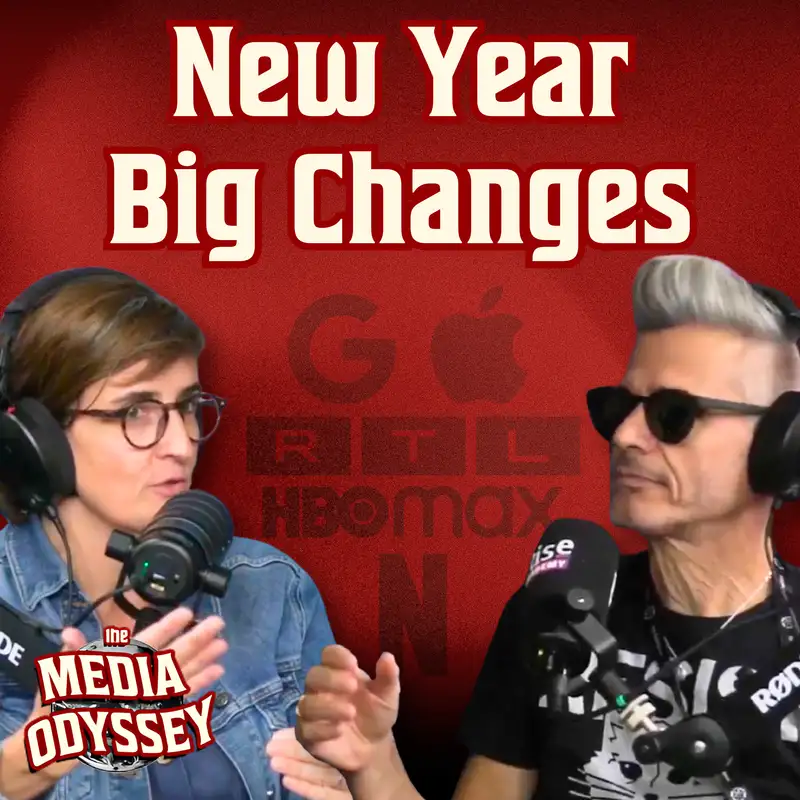
GOOGLE, APPLE, HBO MAX, NETFLIX, RTL & SKY: NEW YEAR, BIG CHANGES!
Download MP3Marion Ranchet: [00:00:00] Okay, so it is week two, three of 2026. A lot has been happening already, like I'm, my mind is blowing up. We chose two pieces of news. And so I chose one that is very Eurocentric but I think could be, an interesting case study for what a lot of companies have to go through right now, which is they have to navigate this space without knowing what's gonna happen next.
And you have one that is a bit more global.
Evan Shapiro: Yeah, and your topic starts in Europe. You're absolutely right, but then expands to incorporate the Netflix Warner Brothers deal and Paramount and all the mishigas going on there. And my topic comes from America. It's about two big tech companies, Apple and Google, and the fact that Google just hit $4 trillion in market value.
But this has implications in every territory around the world, and large implications for tech this year.[00:01:00]
We're gonna start with HBO Max finally. Finally, after a number of name changes launching in Europe in a real way, after not having done so in a while. Specifically in Germany is the topic that sparks this conversation. But tell us why this is important, and more importantly, tell us why HBO Max finally launching in Europe means so much more to the rest of the industry.
Marion Ranchet: So they've been in the region, huh? They've been in a lot of different markets. Netherlands, Spain, France, et cetera. But what's big about this one is for the last few years, they were stuck, locked into a partnership with Sky in some key markets. So France Germany Italy, and a few years back France.
Very much the old way of doing business, which is they licensed their content to a partner in each of those [00:02:00] markets these guys had, the HBO brand, all the programming and,
Evan Shapiro: But no standalone app in these regions?
Marion Ranchet: No.
Evan Shapiro: No HBO.
Marion Ranchet: Exactly those deals, prevented from launching HBO Max.
This deal ended December 2025. And so come last week where Jan 2026 and they've launched in Germany, Austria, Switzerland, and Italy. And in a couple of other markets like Luxembourg, Lichtenstein, if you want.
Evan Shapiro: Uk?
Marion Ranchet: No. UK's coming up in March. We have three as well.
Evan Shapiro: So up until this point, HBO O Max has not been launched in all of these territories and is still not launched in the uk.
Yeah, so there's this larger story here, which is they're super fucking late to the streaming game. Around the rest of the world compared to the rest of their competitors, which is one of the reasons why they're in such weak position in the marketplace and ready to be acquired. So there, there is that part of it.
So they're launching here and the way they're launching, the way you describe it in your Substack newsletter, Streaming Made Easy is incredibly insightful and detailed, but just give us [00:03:00] a top line of the approach that they're taking, given how late and far behind they are, the rest of the big publishers.
Marion Ranchet: Yeah. Knowing that the UK and Germany are the two biggest M and E markets in Europe, right? HBO has 128 million subscribers in all of those different markets. So they're hoping that those new launches. That are so big, are gonna really, push them, upwards.
So in terms of the launch, you are five, 10 years late depending on who you look up to. A Disney, a Netflix.
And so what do you have to do? So from the get go, there's knowledge about the programming. Little knowledge about the brand, really, right? Because the brand was embodied by someone else, Sky. So there's a bit of work to do like that. But of course, at the bottom of this is that you need to be as widely distributed as possible.
So even before the launch was effective, they actually announced a deal with RTL plus they're building a bundle so you can get RTL+ and HBO Max in Germany [00:04:00] combined. So a lot of people are saying, what a lousy move because it's a commercial broadcaster. What does it have to do with anything?
TL plus is actually strong of several million subscribers. So that means that right out of the gate, HBO Max is gonna be featured, showcased to that customer base. You had to that the fact that RTL is the biggest commercial broadcaster in Germany. There's a a brand, Halo effect, so to say.
So that was a fascinating, yeah.
Evan Shapiro: It's hard for, I think, Americans to put their heads around what RTL equivalent would be here, but to a certain extent, this would be like distributing with Disney to a certain extent because you're getting ABC, and Disney plus a pre-installed streamer, a very large broadcaster commercial.
It's a little like if BBC iplayer and them combined in, in the UK the difference there being that's purely a public broadcaster and no advertising on a lot of their platforms, including their streaming service, but it is a little bit equivalent as if they had teamed up with Disney [00:05:00] here or Amazon to a certain extent, but Disney because of the broadcasting, the ABC of it, right.
Marion Ranchet: Speaking of Amazon. Second deal they announced was an extension of the partnership that they already have in the US and other key territories with Prime video. So clearly you have RTL, very local, and then that moved the global player. And we all know, right, how powerful prime is, and especially in.
Evan Shapiro: so this is aggregating HBO Max across prime to prime subscribers for an upsell for an additional price. But then you're paying Amazon a piece of that.
You made a point in your piece in your newsletter Streaming Made Easy that, Amazon's huge in Germany. And so this is a, this is not as big as RTL, which is the market leader in Germany. So that bundle is gonna be very effective for reach. But now you're with another top three player, which would be Amazon Prime.
Marion Ranchet: Actually, what's tricky right, is that, the RT L is playing in a, they're playing in a lot of lanes because they're a commercial broadcaster, because [00:06:00] they're trying to also be a premium streamer. They're mixing all of that. And so if you look at the play around RTL plus combined with Sky Germany and we'll be talking about that, they could become the number three in the market with 11.5 million subscribers right now with seven, I think there's not a lot of data on subscriber accounts, but it's Netflix, Prime, Disney being in that top three.
But yeah, absolutely they're, what they're doing is, they're looking, they're scouting who's in market, who can I, use in a way, to jumpstarts and grow very quickly.
Evan Shapiro: And crucially, they're going from a licensed product that runs on Sky.
So it's product that's embedded in a Sky Pay product, which is again, compared to the United States, we have to really make the difference here. Pay TV cable. In this case, satellite in Europe is much, much smaller than it is in the United States. Much much, much smaller. Yeah. So they come from an embedded product there to now widely distributed on RTL and [00:07:00] Amazon as a standalone app. Correct?
It is not disaggregated or disintermediated. It is the standalone app for sale, much like it is here on a lot of cable and MVPD products in the United States, but they're going wider than that. This to your headline in your piece in Streaming Made Easy, your Substack newsletter is go big or go home.
So th there your point I think is be on every shelf space you can possibly be. And this is their approach to all of Europe now, correct?
Marion Ranchet: Yeah, absolutely. And what's interesting and the reason why, perhaps sometimes when you guys look at what's going on and the partnerships deal that you are seeing, you're like, why this and that.
In the US I think you see the deal with the Charter and co you do Roku, you go direct, you do Prime. But would you do a bundle with another broadcaster streamer? Question mark. We're starting to see,
Evan Shapiro: but with Amazon, you're doing that here in the United States, everybody chooses to partner with Amazon.
Everybody now, yeah, chooses to partner. I think Netflix has either done it or about to do it.
Marion Ranchet:No, they haven't done it.
Evan Shapiro: They will. That will happen this year.
Marion Ranchet: [00:08:00] And Disney either actually.
Evan Shapiro: Because they wanna control all the signups. Of course, there's gonna come a point where both Disney and Netflix join a bundle. That was my barking dog. There's gonna come a point where Disney and Netflix join a bundle with Amazon 'cause they're not gonna have a choice.
Retail is now number two, bundler on the planet earth. We know this from our friends at Bango. The number two bundler after Telco. And that's the other big thing.
You're gonna find Netflix and Disney in these bundles, which again, is why this rollout for Max is pretty indicative. I did an interview with the LA Times, which you can go read where I called this one in a pattern.
If you look, if you go back and France is another market where HBO Max is now attacking. If you go back and you look at the Netflix TF one deal and the Amazon France television deal. This is one in that pattern. Yeah, this is not even the first one of these deals. RTL x Max. And it won't anywhere be the last. We're gonna see a lot of superb bundling with, and I think this is really important, each country, it's like having a different [00:09:00] major broadcaster in each state in the United States, each country in Europe has a major player like RTL, like BBC, like France Television who are going to be powerful partners for the American and global streamers.
Marion Ranchet: Yeah, absolutely. I think there's no, everyone is being very pragmatic. There's no way to actually win, alone. Deals that were, impossible to think about a few years ago are being done right now in terms of the timing. It's an, it's insane when you think of it. I don't know if any of those deals were negotiated.
I think a lot of those deals were negotiated before,
Evan Shapiro: a long time ago.
Marion Ranchet: Oh Yeah.
Evan Shapiro: Years. Like a year and a half ago.
Yeah.
Marion Ranchet: Yeah, absolutely. Probably signed either before or these last few weeks. And the question is, did any of those distribution players have put any provisions in there in, in terms of, what's gonna happen when Netflix buys you?
Evan Shapiro: Honestly, I think that the richness of the deals that they've set in place, which they set in place a long time ago.
Marion Ranchet: Yeah.
Evan Shapiro: I would say before they decided to split. [00:10:00] Because as they come up with that split idea, which predates the bidding war, right? And this is why this story is much larger. Now we're into the Netflix Paramount offering for HBO Max part of this conversation, they had to have made those decisions before they decided on how to split up the company. They had to.
And but part of that is look how good these deals. Look at all the upside in Europe alone, Ted Sarandos.
Marion Ranchet: Yeah.
Evan Shapiro: In Europe alone with all this con content, David and Larry Ellison, because David doesn't do anything that Larry's midsection doesn't tell him to do. There's a lot of up, this is one of the reasons why the valuation of Warner Brothers is climbing while Netflix and Paramount plummet as they make these ridiculous offers.
And as we discussed this right now, yesterday, Paramount threatens to sue the Warner Brothers board and they want details of the Netflix offer. Today we hear Netflix is redoing their offer to be 100% cash, [00:11:00] which is exactly what Zaslov wanted from a competing offer from Paramount.
And so the richness of the potential upside and I think we should talk about pricing too. 'cause the pricing approach for HBO Max is also I think, really clearly. Indicates that these decisions were made last summer, last spring, maybe even as long as a year ago. Talk a bit about how they're rolling out the pricing in each one of these markets.
Marion Ranchet: We're paying in Europe less than you guys.
I'd say 20, 25% less than what you're paying. We've seen HBO. Yeah, for HBO Max we're, we've seen some price increases at the back of last year in some key markets, but interestingly enough, in France it stayed the same, which tells me that maybe they're seeing some sort of price sensitivity or struggling to acquire subscribers.
'cause out of all of those EU5 very strong markets. It's the lowest, but so they decided to go for a 5,99 11,99 and I think 17,99 or [00:12:00] something. There's no launch promo, which they had done in the past, which is a deal that I got when they launched.
Evan Shapiro: So that was a 50% off or six months free.
Yeah. Big mistake or something. Yeah. They could never claw back the price. Yeah.
Marion Ranchet: They've tried, or they've written to me many times telling me that, I'd be moving to, the basic with ads and et cetera, et cetera. So all in all, they're trying to play catch up with that. But they've noticed that, of course it is helping you to acquire subscribers at the top.
Forever pricing like that, it's actually, a challenge, from a margin perspective in the long run. Just one thing, just to finish up on that, what's interesting about the pricing, it, it is cheaper than in the US. It's pretty aligned with other markets except for one thing on sports, right?
They have historically had the this add-on, which is legacy Euro spore. All of that pricing you've seen it is. Exclusive of sports. Oh wow. As a matter, as a rule, right? In most markets. So there's, it's a bit more expensive than, it elite to believe. [00:13:00] Having said that, as part of this launch they've decided to isolate the Winter Olympics, meaning that all plans will get access to the Olympics
Evan Shapiro: Without the sports add-on?
Marion Ranchet: Without it.
Evan Shapiro: That's a huge difference here in the United States. NBC has the Olympics locked up forever, right? But in Europe, HBO has a lot, max has a lot of sports. That they don't have here. Yeah. They, that's one of the reasons why Sky was so into them was they used them for as a sports product as a great deal as its own tier, I believe, or some kind of add-on example.
And that's again, I think why these plans have been laid out for some time. They will be a very big value add to either Paramount or Netflix in Europe. Yeah, for years and years to come because of these great packages, including the frigging Olympics. That's really important.
Now, we should also note that each one of the countries in Europe will have the Olympics on their broadcaster, but not in sometimes the same depth that that disco brothers has.
Marion Ranchet: No, it's they did this with [00:14:00] they launched in France a few weeks ahead of the Paris Olympics. So it is a move that they've made in the past. The reason why they're repeating, they've seen that it is a major acquisition driver, and I'm assuming they've managed to keep people, to retain those those subscribers that they got from the launch, from, such a big, sports event.
One thing that is important is that it looks cheap as it is right now, but, so talking about, the potential impact. Of this thing.
Evan Shapiro: So seven bucks or eight bucks for this consumer if they want sports this year and then goes to $9 next year if they want sports. Is that right?
Marion Ranchet: No it's three three euros add-on.
Evan Shapiro: Oh, wow. So it goes from six to nine this year. Yeah. And seven to 10 next year. So it, you can lock in the price for life if you subscribe this year at six and nine, and then next year it climbs to seven and 10. Yeah.
Marion Ranchet: Exactly.
Evan Shapiro: Six, seven, by the way.
Marion Ranchet: It's extremely cheap for you guys. Not so cheap.
I think for us,
Evan Shapiro: not in a territory where you're already paying for RTL plus [00:15:00] probably, and then you get all this free broadcasting from whichever country you're in. Or a RD and ZDF in Germany.
Marion Ranchet: Yeah.
Evan Shapiro: France Television. In France, BB, C and the rest in the uk. Yeah.
Marion Ranchet: So two things right about and then we can move on around Netflix and everything, because how challenging, it must be to work towards that launch.
And the UK is gonna launch in March knowing that by the end of the year perhaps, you have a new owner. I wonder if this will have an impact on consumers, should I get it now or should I wait because I have Netflix? Question mark. I don't know.
Evan Shapiro: Do you think most consumers understand the territorial nature of those types of things?
I mean we do. We live in a bubble though that we are listeners. This is a community that pays very close attention to this.
Marion Ranchet: I agree. But
Evan Shapiro: I either want Game of Thrones or I don't want Game of Thrones.
Marion Ranchet: I agree. But Netflix did write to every single consumer. On the planet.
Evan Shapiro: Okay. We're getting this.
I know. Yeah. I think I, I think though this European rollout is one [00:16:00] of those things is and March, you got March Madness coming out here in the United States very soon. Which is a massive television event across all of the Disco Brothers properties. But I let's twist to this.
This thing is so far from over and Netflix acting as if is just really silly. They look moronic. Ted and Greg walk strolling around a lot with Zas is gonna look like painting the infield too early during the World Series. It's just silly. And it shows that this is about not always money. A lot of times it's about ego.
But we have these twists here. So Netflix is now sharpening its pencils and revising its deal offer, which they swore that they wouldn't do. Just like they swore they never take ads and never do sports and never become TV. They're becoming television. And the Ellisons are now suing the Warner Brothers board to see the details of the Netflix deal.
And those things happen one after another. Crucially, right now, if you look at, since the bidding began paramount. Value its market valuation is [00:17:00] down 36%. Netflix is down 25%. It's down 120 ish billion dollars in valuation. Meanwhile, Warner Brothers Discovery, Disco Bros is up 40 plus percent.
Marion Ranchet: Yeah.
Evan Shapiro: Zas is making these two guys look stupid. The three guys, if you include Greg in this Ted and actually four guys, Larry and Davey and Greggy and Teddy are all looking silly sharpening their pencils, offering more billions and billions of dollars.
On this, my question to you is, I, now that we've looked at Max through the European lens and how much pure upside here in the United States, we see Max as fully penetrated. Yeah. As disgusting as that phrase sounds. When you mentioned David Zoff and penetration the flip of that is in Europe they have a ton of ground to make up. Yeah. Because they're really behind and so there could be a great deal of value. Both companies who are bidding see. In jumping in here, but how do you see, is this a really good deal, just purely from the upside in Europe?
Potential for both Paramount [00:18:00] who already owns Channel five and Netflix, who has deep penetration in a lot of these territories. It's the number two streamer in many of these territories. What do you see when you look at these this battle for Warner Brothers discovery?
Marion Ranchet: So honestly. To me, the best distribution playbook has always been Netflix and everyone is playing catch up.
The only difference being that, they are not making any concessions, right? So right now I don't wanna be in Prime and they're very careful where they're being bundled, et cetera, but they are pretty much everywhere. So HBO can gain from that. I don't see how Netflix is gaining anything from HBO on that front.
So the gain from HBO is very much the brand, it's the programming the sports rights. So for sure, 'cause that means Netflix would be owners of the Olympics to de France. So many.
Evan Shapiro: 'cause I think that's what it's all about, I think it's all about that, is if you look at their worldwide strategy, it's about live and sports.
Christmas Day had two [00:19:00] big, huge football games, two big, huge football games. One of them really the most live streamed event in sporting streaming history. So I think that's, there's a great deal of value there. Associating. Yeah.
Marion Ranchet: And. Let's be also mindful of, the library, the IP, we love movies. We go to the movies still. So there's a lot of value in doing that.
The only thing being that we're very pro-regulation in Europe when it comes to windowing strategy. So when we hear Netflix saying, oh, we'll give you that 17 days thing just on the French market, to give you an idea, when Netflix.
Produces co-produces a movie that goes to theater. It can only show it, stream it 15 months later,
Evan Shapiro: right?
Marion Ranchet: Not 15 days, 15 months. There's gonna be a lot of, lobbying and regulation on, on, on that front. They're gonna be shaking that ecosystem.
Evan Shapiro: I wanna go back and double click on something really important though.
Up until this point, most of the HBO library, the most of the Warner Library through the HBO deal, 'cause not all Warner [00:20:00] stuff airs on HBO Max, but most of it eventually gets there for a long period. Most of that stuff has been trapped behind a Sky paywall, which is not a very highly penetrated product in the European markets.
Correct?
Marion Ranchet: Yeah. It is, yeah. It's a small, we're talking
Evan Shapiro: 10%,
Marion Ranchet: three, 4 million in Germany. Yeah,
Evan Shapiro: It's tiny compared to everything else. So a lot of that content is completely under exploited. The Warner library is very under exploited in the territory compared to United States. So it does feel like both companies are weighing Europe, 400 million people.
Marion Ranchet: Yeah.
Evan Shapiro: They're not distributed in the UK basically. Yes. Just behind the Sky paywall, which is less than 10% of viewership in the UK. In Germany it's about the same thing.
So we're talking about a massive upside there. So I think that helps explain some of the irrationality around Paramount, especially when you consider the Olympics and other sports there.
Some of the American [00:21:00] view of irrational bidding that's going on. Is that a fair statement?
Marion Ranchet: I think that's interesting. I hadn't thought of that. But if you look at what Netflix has to gain in the states, we've seen it, right? Not much. There's a bit of a plateau. The growth is often. EMEA, APAC and latam.
So if you look at it from that perspective yeah I see what you mean. There's a lot of, and especially because one, regardless of Sky, but was very much in the business of licensing, all around the world and there's a lot of library.
Evan Shapiro: It's completely different business.
I agree. Yeah. Completely different business than Netflix is in. And then there you add to the fact that now all these eyeballs add added ad impressions and suddenly you can start to do the math there. Where from an a purely American standpoint, as I have been taking all this time, this looks like bad math.
It makes a little bit more sense when you look at it through the lens of, Hey, there's 400 million people. This content isn't reaching from a subscriber standpoint. A, it may not get them any, that many more new [00:22:00] subscribers, but retention, absolutely from a content depth standpoint, and then the Olympics and sports.
And it could bring in new subscribers, but certainly new ad dollars.
Marion Ranchet: I would, so what's gonna happen for consumers most likely. It's the price are gonna almost double the Netflix when they get HBO. If there's that much live.
Evan Shapiro: I think yes ads. So I think yes. And without ads, absolutely.
But I think with ads, I think there'll be a better pricing for them.
Marion Ranchet: I agree with that. But with that ads, oh my God, I have the two subscription. I would take one that has the two. And even in terms of that simplicity of watching content, et cetera, one bill the customer. The customer, the viewing experience the Netflix product is better.
Let's be as it is right now, it is better than HBO Max. So what's gonna happen is big price increases, but I think. I don't know if they're gonna be able, if Netflix is gonna recruit that many new people, I think it's mostly gonna be.
Evan Shapiro: We agree. Thank you. But you look at [00:23:00] the Digital Eye data that you put out in your report, in your piece Streaming Made Easy a Substack newsletter.
Marion Ranchet: You'll see I've paid you rights to mention that so many times.
Evan Shapiro: but that's what happens when I turn my power on someone else.
Marion Ranchet: Yeah. I love it.
Evan Shapiro: No the key here is you show that there's a huge upside. So Netflix, in that same Digital Eye data, Netflix is actually doing quite well in adding people to its ad tier.
Yeah. HBO Max sucks at that. They're terrible at it. Yeah. Here in the US and in especially in Europe. And so I, we agree it's more, hey get a few more people, especially given the sports of it. Yeah. But then also upsell the ad tier, which is where a lot of the growth will come from. Yeah. So I think we, we've shown really well why this is, this RTL, HBO Max deal and HBO max hitting Europe is much a much bigger deal. A much bigger issue with bigger implications around the entire media universe. Yeah.
Marion Ranchet: Yeah. And let's wait for the launch in March. And also there's a lot more,
Evan Shapiro: there's
Marion Ranchet: a lot more big [00:24:00] deals that are missing. So my gen tab, biggest telco in Germany, no deal.
I haven't seen any deal.
Evan Shapiro: Yeah. There's all the telco deals, right?
Marion Ranchet: Vodafone. So a lot of those, and I'm thinking Magenta being so big, we're talking 4.7 million paid TV subscribers. They have a lot of bundles. They're bundling, plus they're bundling everything. Everyone, they are the super aggregator of Germany.
I'm thinking they do not like, having this Netflix slash HBO Max deal.
Evan Shapiro: No, that's gonna, that's a good, that's a good point. So yeah, your point I think there's a larger bundling is gonna continue all year long and the major bundlers in Europe in particular are the telcos.
Marion Ranchet: Yeah.
Evan Shapiro: And so there's lots of other shoes to drop.
Disco brothers is out there. Ha. They have to operate the company as good stewards, although it's really doubtful that David Zaslav could ever call himself a good steward, although he has mastered, managed to get the price back up to a place that it's never been in his entire tenure just by putting it for sale.
So credit to him on that.
Marion Ranchet: Yeah, he [00:25:00] doesn't care about any of the steps you are taking at him. He's so comfortable.
Evan Shapiro: I know he's doing quite well and he's gonna walk away with a half a billion dollars personally when that deal closes. But that deal is a long way from closing. Yeah. So as good stewards of that company and to make sure that deal closes at the optimum price, they have to continue to go out there and make those bundling deals.
Yeah. So we have to keep watching every Max deal with a Vodafone or a Magenta or an O2 or Liberty or anyone like that, we should be paying attention to. 'cause that's one more leverage point that Zaslav has in his negotiations with Sarandos and Greg. Whose name, last name I can never remember. And and Ellison.
Marion Ranchet: Okay. Enough with Europe enough with. Yeah, we love you guys.
Evan Shapiro: I love you guys. I love Europe. You know I'm coming there soon.
Marion Ranchet: Okay, so let's turn to the US. You are saying it's very us but it is a, it is, it has global implications. So I think that's why it's interesting to discuss on the pod. So what's happening [00:26:00] on your map?
Something's happening on your map, right?
Evan Shapiro: So I think it's, this may have fallen off the radar. A lot of people, 'cause it's the beginning of the year CES was there, everybody's talking about a bunch of different things, including the world being on fire. But. Inside all of the data that we see every day.
In the first week in January, on January 7th, Google surpassed Apple in market capitalization in total value. For the first time this decade, it's only the third time ever, and every other previous time, it was just for a couple weeks, it has, it had stayed there, and then a couple of days after it's surpassed Apple in market cap. Google hit $4 trillion in valuation for the first time ever.
And I think this missed a lot of people's radar, and I think that's because, oh, these things happen. Companies go up and down. Microsoft was more valuable than Apple was more valuable than Microsoft. Nvidia was at $5 trillion this past fall, so it's just a stock price thing.
And these things balloon and come back down. And yes, it's tempting [00:27:00] to look at it that way, but there are a couple of other data points that I wrote about on my Substack newsletter, Media War and Peace last week just before CES, that point to this being a much larger trend and a much bigger story inside media, big tech and AI in particular.
Yep. And so to add on to the data point that Google is now worth 4 trillion, it's worth more than Apple. Last year in 2025 for the first time ever, Google search revenue. Google search revenue alone surpassed iPhone sales revenue.
Marion Ranchet: No,
Evan Shapiro: that's never happened before. That's a big moment in time. And it's a big change in fortunes over the last number number of years.
And it didn't just beat it, it beat it handily. 230 billion to 209 billion.
Marion Ranchet: At a time where search revenues are actually fragile. On Google's side because of AI. We'll speak to that.
Evan Shapiro: Let's, we can talk about that for a second. Yeah. So I can talk about why this is [00:28:00] such a big deal. To be blunt, search revenue, search and intelligence revenue, advertising revenue is now more than 20% of the advertising economy, and 97% of that goes to Google.
Marion Ranchet: Yeah,
Evan Shapiro: so search revenue continues to climb it. It grew at a nice clip last year. It will grow at another good clip this year, but it will flatten. That is a flattening business. There's no question about it unless you take search and you wind it in with intelligence. If you see AI as the next generation of search, then absolutely those two things together are still a growth industry through the end of this decade and far beyond, as the market keeps indicating by overvaluing a great deal of these AI products.
But it's another data point there is that last year, so it wasn't the first time ever, but it's only the second time after 2024, Alphabet's net income is now substantially [00:29:00] higher than apples. So Google, its number one product. 56% of its revenue is now bigger than the iPhone, which is 50% plus of Apple's income.
If you look at Apple iPhone revenue over the course of this decade, it is basically flat. If you look at search revenue absent one year around co, the post COVID correction, it is up and to the right for search.
And then you think about. The AI market. So let's lean into that. And so a, the reason why Google is now worth more than Apple is a much larger market re stacking intelligence is now worth more than hardware, right? And if you look at the intelligence bundle that is Google, not just search, but the two largest search engines on Earth, Google, and YouTube.
The largest television channel in the United States. Barb just put out a piece of data that YouTube beat BBC on in certain [00:30:00] metrics with all consumers.
Marion Ranchet: Three minute conception, not
Evan Shapiro: But as I predicted a year ago. Yeah. We are seeing this happen. And then you add Gmail and and browser, which they have 67% of browser. And you think about this as an intelligence bundle. And then you think about AI itself, which I have written about recently in my predictions article for Media War and Peace, my Substack newsletter.
I went into great big detail about the circular, the closed loop, the circular economy, the circle jerk economy, as I like to call it, and talked about it at CES, which is Nvidia and Microsoft all buying each other's stuff and round tripping a trillion dollars and fooling people into this idea that it's gonna be, that AI is gonna be a subscription revenue product.
It will not be a subscription revenue product only, it'll be part of the subscription economy, but Google sees AI as search. The next generation of search. [00:31:00] Google search serves 10 billion searches a day. Every single one of them comes with a Gemini ad in the upper left hand corner. Yeah, most of them come with Gemini results open, I'm sorry. AI overviews.
And if you listen to pin chart, the CEO of Google, they see AI overviews monetizing at the same rate as search.
Marion Ranchet: Yeah.
Evan Shapiro: So Google sees AI as the next generation of intelligence of the next generation of search. Search is already outpacing iPhone sales. iPhone sales. That's momentous, right?
And Google of all of the big tech companies in the AI race, if you look at open AI, they are bleeding money and they have no penciled out math. To prove that's ever gonna change. And most of the AI platforms, the long, large language platforms out there are in the same boat. This is not just my opinion, this is Michael [00:32:00] Berry who is behind the Big Short, and a Andrew Ross Sorkin, who is behind Succession.
But crucially, when you look at AI usage itself OpenAI is the number one, Hey, I'm gonna choose to use AI right now. But it is losing market share every day to Gemini. And every day Gemini is serving a tremendous amount of AI usage that isn't in that count. They are going to be part of a much larger bundle of services.
Intelligent flywheel.
Marion Ranchet: Yep.
Evan Shapiro: That Google is serving and the ad product is gonna fund, I think, Google to winning the AI race in a different. Product set. So that's why I think this was a big moment in time. I will stop monologuing now and see if you have any questions about any of that.
Marion Ranchet: I feel like I'm at school.
The teacher will
Evan Shapiro: I'm sorry, but I think it's a much bigger moment than most people seem to be realizing.
Marion Ranchet: No I, no, I completely agree. I think it's always a question of who has an ecosystem, and so we know [00:33:00] Goliath, Google has one. Versus so Apple. Has one, but one that is not, innovating enough and funny enough, on AI, who are they turning to, to get smart to bring, intelligence they're using, they're gonna be using Gemini, not open AI.
No, not anyone else.
Evan Shapiro: Paying Google to use their intelligence.
Marion Ranchet: Yeah. So I think there's a few things, of course I. It's fascinating to see how that company has flipped things around, because a year ago everyone was like, oh my God. Google oh my God, they're being disrupted. What's gonna happen?
Everyone thought, OpenAI
Evan Shapiro: Search, you mean?
Marion Ranchet: Yeah. That open AI was it that they were so advanced? And Google spend the entire year playing catch up. Let's be clear.
Evan Shapiro: True.
Marion Ranchet: But whenever they've released a product nano banana, Gemini, all of those things they've been able to grow.
Is it nano? Is that. Or VO I can never remember. Anyway I'm lose, I'm getting lost [00:34:00] in it. But they've played catch up and they've been able to surpass from a quality perspective what OpenAI is doing. But more important said it because there's a flywheel, because there's this entire ecosystem. They don't have to build everything from scratch, right?
So yes, this can be a subscription, but more importantly it's gonna be advertising. At this moment in time, OpenAI is thinking it is a David, right? It's thinking, okay, how am I building an advertising business? How am I growing that subscription?
Evan Shapiro: I don't think OpenAI is thinking about their advertising business.
Marion Ranchet: I think they are. They're
Evan Shapiro: not in the same, not in the same way they see I, I think when you look at. Most of these businesses, they're focused on a RR recurring revenue.
Marion Ranchet: Yeah.
Evan Shapiro: As the mainstay. And you look at the circular loop that I diagrammed on my Substack newsletter, Media War and Peace, and you can see how they're mapping this out now.
Maybe there's an ad plan in there, but they're not shouting it from the mountaintops and clearly the number one ad platform on Earth, Google. The number one [00:35:00] ad platform on Earth has a huge advantage in the transference of ad dollars in search intelligence to AI. The other important thing to understand about the quality here and the economics, two important points, and it's this it is Google as a closed loop versus open AI round tripping trillion dollars in a closed loop.
Two important things about this, the number of intelligence data points to improve their product, to educate their model is so much larger on Google by a factor of a Google billion. Just think about the number of times you've typed into email and then it's completed your sentence for you.
That is Gemini training. It's creepy as fuck, don't get me wrong, but it has so many more data points every day from every human on earth, right? Two, three, 4 billion people. It's getting smarter, faster, it's providing a better product. It is also marketing itself in subtle ways that, in a way that nobody else in the marketplace can.
Now, here's the other major crucial difference between Google and the rest of big tech, and [00:36:00] specifically the rest of the AI closed loop circle jerk. They don't buy chips from Nvidia. They make their own chips.
Marion Ranchet: Ooh, I did not know that.
Evan Shapiro: Yes, Nvidia is selling chips. Is loaning money to OpenAI and Anthropic and Core Weave and Elon Musk, and then there's a guaranteed deal back to buy chips from Nvidia.
That's how that market works. Microsoft is lending money. To OpenAI and all these other companies and putting money through special purpose vehicles to build data centers around the rest of the world. But it comes back in contracts for infrastructure for them. It's a big round trip. The difference here is Google pays for everything through advertising.
Biggest ad platform on the face of the earth. Net revenue growing, right? Net income growing and they buy their own fucking chips. It's a closed economy. Every dollar spent goes back into the company TPUs, not GPUs. That's a major difference between what Google is up to and what everybody else is up to, and it's why [00:37:00] Apple's buying tech from Google.
You also have to remember that Google pays Apple when you look at Apple's net revenue. Google is paying Apple. This came out in the court case.
Marion Ranchet: Yeah.
Evan Shapiro: $20 billion a year at least to be the pre-installed search on Apple iPhones. That's not going anywhere. And it creates a huge reliance between Apple on Google.
So there's this huge difference shifting in the marketplace and market is valuing Google. I think finally appropriately, there are gonna be a lot of people out there in our comment section that says, yes, monopoly. They've weathered that storm. They felt they fought off all the court cases. Yeah they're not gonna be broken up.
And I think you, you're seeing a major shift, a major recalculation in the entire media universe based on intelligence as the main product.
Marion Ranchet: Okay, let's go back to Apple for a second. You've mentioned the fact that, Google is overpassing Apple in valuation. We're seeing, iPhone sales flattening, et cetera.
[00:38:00] We, we do see the service segment growing. But what are you seeing coming up this year? How do you think Apple is gonna react to that? What is in the books?
Evan Shapiro: Yeah, I think look, Tim Cook has done an amazing job. It is. He is one of the big reasons why that company was and has been the most valuable company on earth for a number of months of the last number of years.
He gets credit for starting the services division, which is the only segment that's really experiencing major growth right now. But they have missed this moment. Very dramatically, specifically AI. But also if you look at their media enterprises, we've talked about this. Apple TV plus or Apple TV is a good product.
Marion Ranchet: Yeah.
Evan Shapiro: But it is, it's limited because of the amount of content they have, they're not taking it that seriously. And I would say that about their entire services segment. So Tim Cook will be gone by the end of this year, and I think Apple's fortunes go with whomever they choose Next. There's a bunch of internal candidates that they're looking at, including Eddie Q.
[00:39:00] And it is definitely a new generation of leadership regardless of who they choose from Boomer to Gen Xer. But Apple has a major examination of itself it needs to do, and who it wants to be in the media world and in the big tech world on a moving forward basis, because they're losing ground to Nvidia, to Microsoft, to Google, especially if you look at the trajectories of market caps, net revenues, and core products over the last five years.
It is a dramatic story between those two companies. So it's a it needs a leadership change. It's probably a year or two too late. But they also are Apple. So you know, Steve Jobs left and Tim Cook took it over and everybody doubted him and he did a great job. So I, this is a pivotal year in the history of that company, though.
Marion Ranchet: Yeah, 'cause you haven't mentioned it, but when you look at the hardware side of business be, besides the fact that, Google is making more on, on on the rest than Apple is making on hardware devices, even on that Google is challenging, head to head our [00:40:00] friends at Apple, right?
If you, I have an iPhone, but if you look at a global level, we're checking one third iPhone and two third on right.
Evan Shapiro: Yeah that's another really interesting point here is in Apple's headquarters their landscape, the place that they're supposed to win, which is the iPhone, right?
They do great on revenues, but as far as market share goes, they are about 70:30 on the wrong side of that to Android.
Marion Ranchet: Yeah.
Evan Shapiro: And so when you talk about user centric media from a moving forward basis, and you think about the day that you start and end with that piece of glass in your hand and you think about intelligence now being the most important product out there, the reach of Android, Google, Gemini, YouTube is so much larger than the reach of Apple and that worked for Apple because they, they concentrated only on rich people for a long period of time.
Things are shifting now.
Marion Ranchet: Okay, cool. So that takes us to our question of the week. Are we entering [00:41:00] the era of commodity hardware?
Evan Shapiro: I think so. I think so. I think when you look at what's happening, like we just said, Android and iOS, the battle there. I think if you look at intelligence now being overvalued more valued than hardware itself. You look at the deals between Roku and Amazon and Vizio and Walmart and Amazon and Google and Roku, I think who makes the hardware, first of all, it's not a very profitable business.
Marion Ranchet: Yeah,
Evan Shapiro: And second of all, I think who controls the intelligence inside is gonna become increasingly important for the rest of this decade.
Marion Ranchet: I actually wonder if 'cause so we were talking about Gemini becoming the AI by default to power Siri. Is that the beginning of them taking over the OS inside Apple devices and beyond? Are we gonna keep talking about OSs or is it gonna be now, talking about ai, what's the AI model?
Who's running everything?
Evan Shapiro: I don't know that those things will wind up being [00:42:00] differentiated. 20 years ago if I had said operating system to you, most people wouldn't have known what that meant. Yeah. There's another key component here that I point I wanted to make. We didn't, we used to pay for email.
No one pays
Marion Ranchet: Really?
Evan Shapiro: specifically for, yeah,
Marion Ranchet: no, you're too old. I don't remember that.
Evan Shapiro: We used to subscribe to AOL, one of the big reasons was email. That's, and we, you say now we pay for water and email is ostensibly free, but it's not because you're paying for it as part of a larger suite of services, we, we don't pay for search except we absolutely do with our attention and our ad dollars and everything else.
AI is one of those, one of those things, and operating systems are one of those things too. They co, you don't pay for an operating system, but you absolutely pay for it. I will say that Apple's operating system is ass. It's terrible. Every time you get an update from them, it's worse than the time it was before.
The current OS is just crap.
Marion Ranchet: And yet we're still buying iPhones. Those who are, you were talking about the fact that [00:43:00] it's a one third, two third market share, but those who are, but our
Evan Shapiro: searches Google, our searches, Google our AI is something else. And you're right to ask that question.
Will eventually the OS be Google's operating system or Android? To a certain extent, Amazon still operates off an Android ish thing with file. They started by building off of Android. 'cause it's open source to a certain extent.
Marion Ranchet: Yeah. Yeah. And it works better than most.
Evan Shapiro: So it's a great question. It is a great question. So I think hardware, look, I love my Apple products, they are very fucking expensive.
So I do think the commoditization of hardware over the supremacy of intelligence is something to watch for the rest of this decade.
Marion Ranchet: Okay, so that's a wrap on episode three.
Evan Shapiro: Episode four.
We just did a live episode earlier this week about the Netflix earnings. Do you remember we were together in the UK? How can you do that? Yeah, so go check that out in our feed if you miss that. We recap the Netflix earnings just hours after they came out. We've got just recorded an episode that'll come out [00:44:00] next week with Sheer Lazar who mapped the Creator Economy with me last fall.
We're gonna talk about that with her and we're gonna talk about her mental health program for creators, which is a super interesting thing that she's been working on for almost a year now. And we've got a ton of other great stuff coming up, including a podcast that we're doing from Lisbon.
At Stream TV where you and I will both be. Definitely join us at Stream TV in Lisbon. We're both gonna be there live, doing amazing content with amazing people. You've got a great whole day of programming. I've got three days of panels in which you're in as well. Passes are now on sale for that. And if you haven't gotten a hint, go read Marion's Newsletter.
Substack Streaming made easy.
And maybe check out mine Media War and Peace on Substack as all. It's great to see you as, oh, I'm sorry I missed you at CES in Vegas.
Marion Ranchet: Yeah, the snow, what can you do next year? 2027. I'll make it
Evan Shapiro: Cool. Thanks for checking out Media Odyssey Podcast. We'll see you next [00:45:00] week.
Creators and Guests