FANDOM > AUDIENCE
Download MP3Evan Shapiro: [00:00:00] Welcome back to the Media Odyssey Podcast. That is Marion Ranchet.
Marion Ranchet: And that is Evan Shapiro.
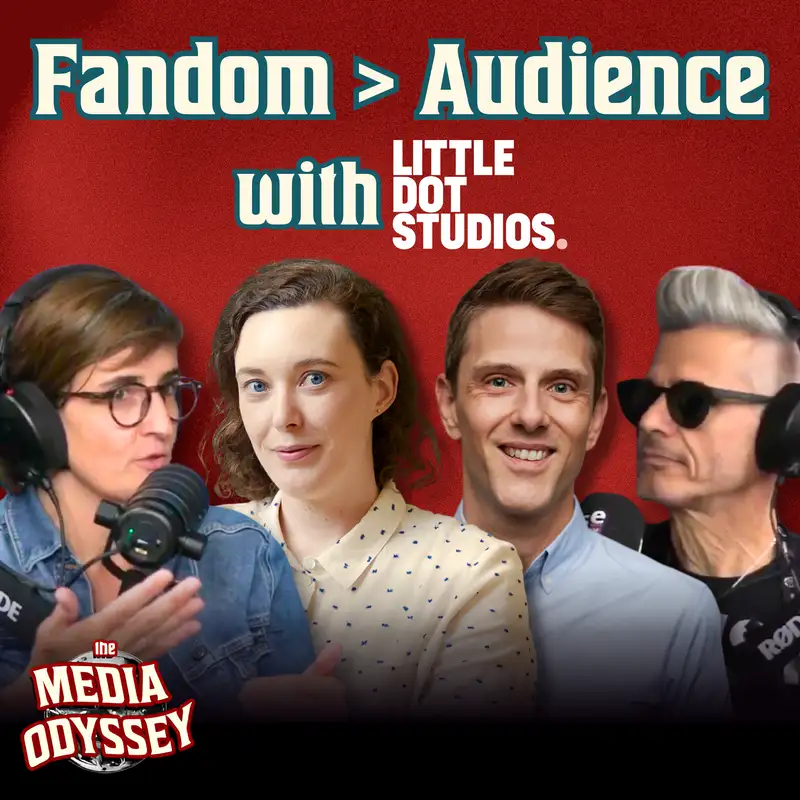
Evan Shapiro: And we've got a really good episode. We've got the folks from Little Dot Studios, and they're gonna talk to us about how to transform modern media enterprises for the fandom age.
I wanna talk about, I was at the International Emmys last night and I actually was able to present to the board of the International Emmys earlier in the day. And you know me, I tend to scream truth to power. And what I found interesting was, I think we've hit a moment, you and I, where the things we've been saying to people out there in the traditional media ecosphere are beginning to sink in.
And I watched it sink into [00:01:00] these folks, very traditional media players across the board, although there were some new media folks there as well. But I feel like I'm watching it sink in in real time. But I also seem to believe or I seem to intuit that these folks don't necessarily always know what to do with the information we're providing them.
How do you feel about that?
Marion Ranchet: So what was the tell, you know of that change? What did you actually see? Was it in their interaction? Have they shared anything that led you to, because there's what they say and to your point, what they do.
Evan Shapiro: That's a great point. A lot of cameras go up. A lot of phones go up during the slides and I tend to play, I think you've seen this, play some video from our podcast on screen using case studies from BBC and ITV, World of Wonder.
And you could see the people who are working inside these companies to push transformation. You could see them leaning forward and nodding yes. And then you can see the people who have maybe been a [00:02:00] little bit behind the curve on transformation, leaning back and going, huh? 'Cause the case studies give them examples of, oh, here's a traditional media company transforming you can too.
But it was really more in the comments afterwards where people were saying, huh, would you consider coming over to our company and talking to our, our executives there or whatever it is. But what, what are you feeling and hearing, especially, from the public broadcaster side of things, or the more commercial European TV folks.
What are you hearing?
Marion Ranchet: So it depends what we're talking about. Are we mostly talking about YouTube or are we talking about something else?
Evan Shapiro: It's fandom. I say the thing of, I know I talk too much about YouTube, but they're just the first social media platform that's come to the television. They won't be the last.
And then again, you see that go, oh shit, TikTok is coming to television. Instagram is coming to television. So I think there's a larger perception building around [00:03:00] the importance of fandom, but I don't know that people know what to do with it.
Marion Ranchet: I have to say that it's, I'm not seeing companies not investing in social and YouTube.
It would be wrong to say that they've stayed doing business as usual these last few years. All of those companies media and entertainment, whether you're talking broadcasters, streamers, producers, they've had a social presence these last few years. And thank God, right? I think the difference right now is how much light is shed on teams doing that grunt work.
Because these last few weeks, I did deep dives into TF1, M6, et cetera. And you can see all of these guys are on YouTube. They have a strategy. Is it perfect? No. But they are already learning and testing.
I think the only challenge with this premise that you're pushing forward is of course they wanna invest in those, distribution channels, they wanna push fandom, but [00:04:00] a lot of them are still saying. We're not seeing the money, and at the end of the day, it is what they're, that's their business.
Even France Television, right? It's a public service broadcaster, they have an advertising business and actually funny enough, they were ahead of the game versus TF1 and M6 and the number of channels the number of subscriber views, et cetera. All of those key metrics that are accessible to me. Yeah. I don't have any insights into what is actually happening at France TV on that front.
The money thing is still here, right? So I think we've done just half, half the work. We're not there yet.
Evan Shapiro: Yeah, I think you're right. But then you look at folks like BBC Studios or some of these other enterprises and they are realizing new revenues. Is it replacement for what they're losing? No, but these are brand new revenues from brand new audiences.
Again, the case studies we've done CBC, Channel 4, they've produced brand new revenues through partner sales or through just programmatic ad sense [00:05:00] that are meaningful. Growing to seven, in some cases, eight figures of advertising and other, and then there's the, I just was on a call with Ruth Berry from ITV. She was talking about the number of skins they were selling for Love Island in gaming. And that's the, I think the larger premise is it's not gonna be a one for one replacement.
It's gonna be a brand new set of enterprises around your most important intellectual property that are not gonna be easy and they're not gonna be the normal course of business that you've been doing all these years. It's gonna be completely new things.
And to your point from earlier, test and learn. Don't be a afraid. Don't have the fear of fucking up. Yeah. Lean into the test and learn mentality and then use the data from the things that don't work to try new things that do. So
Marion Ranchet: A hundred percent. I will have to say that it is hard to do that right [00:06:00] now. You can feel the pressure from the ad market. If you look at most of the European broadcasters, they, they haven't had a great year. Their outlook is being revised downgraded, et cetera. In a lot of, the traditional studio outlets, everyone is either, on its way out or already out.
Yeah, I think I'll be more contempt later on next year, so to say. So I'm happy that you see that mindsets are changing. But I think we'll see true results a bit later on next year. Especially once we've seen more money coming everyone's way. The reach, the scale thing, that's just not good enough. At the end of the day, we just need money to flow.
And it's hard to do alone. Which I think is a great segue into the folks that we're bringing on the part today from Little Dot Studios. Let me introduce you to Ben Arnold, who's SVP Commercial Operations and Holly Graham, Chief Commercial Officer.
Welcome guys. Hey.
Ben Arnold: Thank you. Happy to be here.
Evan Shapiro: So let's start [00:07:00] off with the simplest and easiest of questions. What the heck is Little Dot Studios and what TF do you do?
Holly Graham: Yeah. You'd think it was a simple, easy question. So we're gonna try and give you a simple, easy answer. Yeah, we basically work with traditional media organizations and brands to understand, navigate, and effectively monetize digital platforms.
And I guess you guys were having that conversation up top around YouTube versus traditional social and the kind of landscape. And I think that, that when we talk about social, we mean YouTube and social platforms. So yeah, we work with companies to help understand how those platforms operate, how they might maximize them from a strategic perspective, and then obviously the question that everyone is most keen to answer, how they monetize them most effectively.
Whether those KPIs that they're working towards are directly monetizing them through advertising or the kind of other, many other ways that they might do that.
Ben Arnold: And we have teams around the globe that help to do that in so many different ways. We really are a soup to nuts partner.
Everything [00:08:00] from multi-platform production. We have our own network of channels across YouTube and FAST. So we really are doing what we know and what we preach to our partners and our clients. We're doing it ourselves. Yeah. Pretty extensive in that regard.
Evan Shapiro: So between your owned and operated channels and the channels that you're operating across different platforms for your partners, how many different channels across social are you operating at any given time?
Ben Arnold: Yeah, well over a thousand. And, that's really video first. A lot of YouTube, TikTok, Instagram, but also, across FAST and a lot of emerging channels as well.
Evan Shapiro: Is that kind of scale, I have had some conversations with studios and other folks who wanna get into monetization on social and they have two channels, or three channels or six channels.
And one of the things I tell them is, without the kind of scale of thousands of channels, it's hard to A, understand what the algorithms are doing and get the information you need to optimize these channels. Is that an accurate take?
Holly Graham: I think that's right. I [00:09:00] think scale is key. And I think what, as Ben was saying a minute ago, what's key about Little Dot that we have two core kind of playgrounds that we operate in.
One is on our digital media network, which are owned and operated brands where we are running, social media accounts, YouTube channels for our own brands. And then we have our agency business, which is where we're doing that on behalf of our partners.
And so not only do we have scale, so obviously we have a huge sense of like how algorithms are operating, we have a huge sense that is provided to us via that scale. But also we have this kind of sandbox in the form of our own network where we can test things 'cause we, no one knows better than us how precious IP is. And how precious, how brands, need to be protective of their own kind of environments.
Whereas we have our own environment where we can be a little bit more playful, test things out and learn a lot about, learn a lot about the algorithms and what those part those platforms are doing that way.
So I guess there's a combination of kind of scale with an ability to experiment and innovate that helps us out a lot.
Marion Ranchet: And so how do you actually advise [00:10:00] someone who's coming to you, they wanna get started. Are pushing them to do a couple of channels at the time? Are you telling them that they should go big? So of course they can benefit from the network effect of you, but at the end of the day, when they look at the performance the monetization, they will be looking at their own portfolio.
And so there's always that question is, should you go wide or not? What's your take on that?
Ben Arnold: There is obviously always an eagerness to go as big as humanly possible, especially when monetization is a factor, right? So everyone is very eager to make as much money as possible, as quickly as humanly possible.
The reality is it does take time and a bit of a more thoughtful, strategic approach. The amount of content you have is also a really limiting factor, and I think that's where a lot of the partners we work with and, what we experience is that quickly becomes an issue. It's not inexpensive to produce content and to do it effectively and at scale, to really have enough content out [00:11:00] there to gain traction, build audience, and widen that audience is not something that happens overnight. But once you do have that scale, you can find that things. Start to multiply quite a bit quicker.
Holly Graham: And one thing I'd add is you don't always know what the hits are gonna be. So like we work with a lot of partners where we're working with studios on like multi-IP projects. So we're working across their whole range of their portfolio or we're working with the distribution company, we've got access to their whole archive and they'll come to us like, we wanna do these five shows.
And we are like let us take a look at the long list 'cause we might see something you don't. And I think that's another benefit of having been doing this for 13 years and also having, doing it at the scale we're at, we have that gut instinct of oh, that could be interesting.
But then we also have a huge amount of data to back up, oh, chat shows might work. Or, actually we know that this type of show is really big and this territory or whatever. So let us play with that. So it's it is a balance between not running before you can walk, but also not taking things off the table just because that's your not a [00:12:00] strategic initiative for you, or it's not a kind of key IP outside of digital. Digital kind of has its own rules of what's gonna work. And so I think that's, it's important to be mindful of Yeah, the long list, of what could be on the table.
Ben Arnold: That's a great point. We can really see value where others can't, even if it's their own libraries. I think knowing the landscape and the platforms inside and out, we have a pretty good eye for what will resonate or how to take something that has existed in one form for a long time and make it work for a platform like YouTube and, the various formats that exist on that platform.
Evan Shapiro: Yeah, I think everybody wants this one size fits all model where I'm just gonna come in, you're gonna, you're gonna cut me a slice of pizza, I'm gonna eat that pizza and I'm gonna be full. And that's just not how it works. It's much more bespoke. With, I, we've been talking a lot about key passion indices and the importance of fandom.
We talked about it with the head of marketing of the Philadelphia Eagles. Ben, I know you're a Birds fan.
Ben Arnold: Go Birds. Yeah, if you say so.
Evan Shapiro: [00:13:00] But that's the key element here is you seem to hand tailor the approach based on the fandom with regards to that specific intellectual property.
Is that, am I reading that correctly?
Holly Graham: I, no, that's completely right. And even layering on the platform. So yeah, it's not only that unique,
Evan Shapiro: It's different for each platform. It's not the same for each.
Holly Graham: Yeah. And even you think YouTube shorts might come along and be the same as TikTok 'cause like same aspect ratio, right? And it's oh no. No. It'll never be that easy that we can just, and I think that's where it excites, like that's where people like us come alive because you can, you need to know what you're talking about and you need to know how to make stuff authentically for each platform.
But if there was a like AI solution that could cut a video into the best practice for all of these platforms in one go. They might be able to do that from aspect ratio perspective. They might be able to do that from a runtime perspective. They might be able to do that from whatever, but they can't do it from a, like what people are talking about on that platform or what people care about on that platform or particular demographic is on that [00:14:00] platform.
So yeah, unfortunately the overlap isn't that easy to map without really just knowing the platforms and the data that backs them up.
Ben Arnold: And how people experience these platforms and use them is so personalized at this point. I think YouTube in particular has done such a good job of giving people options to fit how they want to experience.
Some people might only watch the Shorts feed. That's just how they're getting their YouTube every day. Others, and we're seeing this obviously with a lot of the numbers, two thirds of our network is viewed on CTV. People are leaning back and watching YouTube on TV. You're seeing different ways of engaging.
And so that all plays into how to really build a content strategy for just one platform like YouTube. There are many platforms and, many video platforms, but they're just such a variety of ways to experience, content. And so our job is really to determine what that is for everyone we work with and lean into that to ensure their audience is growing and certainly we're driving engagement on top of that.
Marion Ranchet: [00:15:00] You've mentioned the term IP a lot, and so when you have partners coming to you, are you suggesting them to go IP based, meaning single IP, the name of the channel is the name of the program, or are you also mixing and matching with a bit of a genre based approach. I've seen that, amongst the channels you have in your network, it feels that this is what you've done, right?
You've created a brand new brand, so to say. And then you've you are tailoring the content of each of those channels per specific genre, which, I assume you chose those because you saw the traction coming up in France.
Holly Graham: Yeah. It's a really, it's a really interesting conversation and I think the answer is it depends on the kind of value and the scale of the IP that we're talking about.
So if we have a show, a TV show that has a long legacy, it's got 10, 10 seasons, or it's got 12 seasons and it's got some brand equity around it, or particularly in some of the examples we work with, it's got a lot of meme culture around it or it's got a lot of kind of people [00:16:00] engaging with it, then you're obviously gonna wanna go IP first and go really deep.
Where sadly, that is obviously the privilege of the few is to have a show like that and be able to exploit it on these platforms. And so that's where it's like, how do you get creative to say okay, what are we gonna do and what's our particular challenge? And I think personally I think it's a long path to build brand equity to a new brand.
So it is, we've worked on our network for a long time to build out that as brands that are now recognizable. That's not something that's gonna happen overnight. So I guess it's like, how far can you sweat the equity that you have already? And then obviously that's not gonna be available always. So what's the answer if you don't have that?
But I dunno, Ben, if you have any different perspective there.
Ben Arnold: Yeah I also think, you look at the platform you're building on as well, something like YouTube is essentially a giant discovery engine. So what people might be searching for your show title to try to find clips, episodes, content, et cetera. They may also stumble upon your show because they were watching [00:17:00] something similar or, it, it popped up in their algorithm based on, something they were searching for recently. So you have to lean into not just that, the SEO aspect of people looking for you, but also the discoverability and kind of that spontaneity of how your content is served up to people.
And that's really what's driving audience growth on the platform.
Evan Shapiro: You, I wanna double click on one thing. So you said that two thirds of the viewing across your YouTube channels happens on connected television. Is that, did you say that?
Ben Arnold: I did say that, yeah. A quite a large percentage. Yeah. It's certainly the fastest growing and I think where YouTube, that the latest numbers they're putting out, they're seeing explosive growth across CTV more so than any of their other viewing environments
Evan Shapiro: And so that's billions of views per month, just on your channel. And so I think the idea, and we've had this debate here and it happens in my LinkedIn comments very vociferously about YouTube being [00:18:00] television. But the approach you're taking for a lot of the YouTube channels that you're managing is that these are ostensibly television channels.
Ben Arnold: I think in the way that people wanna experience television, they want for, they want access to whatever they wanna watch, which YouTube is the home to just about everything. They want, they accept the ad load that's on YouTube, which is minimal compared to TV.
And, they can experience YouTube wherever they are on their phone, on TV. You know it, and it is a very seamless experience. So it absolutely is. I think two-way, TV is a two-way experience now. It's not one way. You don't turn on the TV and, watch what's on. So I think from that perspective, YouTube really is TV.
And I, I think that's just commonplace for everyone now. I don't think that's a debate.
Marion Ranchet: No, I actually don't agree. On this part. It is still a debate. Just saying.
Ben Arnold: Your favorite debate.
Marion Ranchet: It is what it is. Sorry about that.
Holly Graham: I think marry on some of that is a US Europe like differentiation to an extent as [00:19:00] well.
Because I do think that in, so I lived in the States for three years and I remember moving there and getting my quote from my cable and I was like what you wanna, you want me to pay what for television? It's it, and so obviously in that environment where the costs are so high, you are gonna go to YouTube more quickly or you're gonna go to FAST more quickly, or you're gonna go wherever else.
Whereas obviously where there's, public service broadcasting or there's just more cost effective parts to television as it was previously defined then, that's it's gonna take us a little longer to get to that same user behavior. But I do think, I think it's interesting because I think it's blurring in both directions.
I think people are watching YouTube shows on YouTube. Sorry, television. I can't even now I'm even lost. People are watching television shows on YouTube, on televisions, and it's really hard to argue that's not watching television. And then they're also watching vlogs, or in my case,
Evan Shapiro: My podcast.
Holly Graham: Yeah, podcast. You'd better be. [00:20:00] Architecture Digest, videos about people's homes on television. And it's that's not a TV show, but it's, it's basically MTV Cribs, but it's, it's now and it's like just everything's blurring, right? What kind of content people wanna consume on what platform at what time.
It's all just becoming a little bit more ill-defined, and YouTube's taking advantage of that really.
Marion Ranchet: I love what Ben said about the fact that this is a two-way street or I love that. And I think that's one way where YouTube and others have been really good at building that fandom.
And I know this is crucial to what you guys do, right? And not just, you're not just saying this for the sake of it. It feels like whenever you work on a specific channel folks who are working for you guys in the background are actual fans of that IP, and I wanted to understand how that is helpful to have that kind of, super fan workforce, so to say.
Ben Arnold: Yeah, no, fandom is at the heart of what we do. It is completely core to our strategy. [00:21:00] It's actually one of our company values and it's, it's something we live and we celebrate globally. But, we couldn't do what we do if we didn't live in that world. And I think, when we come to our partners, we really have to express how to succeed in an environment like certainly digital, but specifically YouTube, you really have to not only speak the language and understand what people wanna watch and how people are engaging, but why people are there and why they're actually celebrating your brand or your content. And so we lean into that.
We, the approach we take is essentially building our staff out of super fans. The people that work on the projects that we have are fans of the content. They might even be content creators themselves. And so they live in the world. They understand it and that is really the key to success.
It's that authenticity. It's the ability to speak the language and understand that world. Fandom is yes, it's at the core of what we believe makes a partner or a brand [00:22:00] successful on YouTube. But it's really I think, celebrating the idea of content and content being that kernel that is at the heart of the fan experience.
So someone might discover a show they really like, then they go on YouTube and find a bunch of content from the show producer, the IP owner, then all of a sudden they're making their own content. Then they're out in the world, buying merch and trying to live and experience.
And it's it's at the heart of it. And so our job is to identify that, build upon that and make sure that we're talking to audiences in ways that celebrate that and bring that to life.
Evan Shapiro: Yeah. I think it's, I think there's this misunderstanding that we can just build this practice internally ourselves.
But everything you've demonstrated the bespoke, handmade nature of every channel. The fact that you're hiring super fans for every piece of IP, this is not easy. This is not simple. This is complicated. It's hard work, and it takes a tremendous amount of resources to do this correctly. [00:23:00] And I, that's one of the myths I wanna help dispel out there in the universe is you have one channel.
If you're ready to hire a whole bunch of people and spend a tremendous amount of resources building out your YouTube channel, then fantastic go for it. But there are really good partners like yourself out there who can bring the specialty to the table and accelerate the progress, through expertise and experience and through the, a massive amount of data that's coming your way.
I wanna take this opportunity to transition to some case studies. 'cause we found that on the pod it's very useful to speak in specifics as opposed to overriding generalities.
I think the most important case study or the biggest case study that people may know you for or know about as a result of your work is probably one of the biggest shows in the world, which is Gordon Ramsey. You've been working on that IP across his various shows for a number of years, right?
Holly Graham: Yeah, we've been working on Gordon's YouTube channel certainly for, I think it's 13 years. And I can tell you that because we started the day [00:24:00] that I started working at Little Dot Studios, and I've been working at Little Dot Students for 13 years.
Evan Shapiro: Wow.
Holly Graham: And we started,
Evan Shapiro: Did you start when you were 12?
Holly Graham: I was, well thank you.
I was the fourth employee and we're now 500. So I've definitely been on the rocketship from the beginning, but no the Gordon. Yeah, so I guess when we come to Gordon, it started as a it's retroactively strategic in that we really started uploading. clips of his TV shows onto YouTube as a kind of okay, that's what everyone, actually that wasn't what everyone was doing. That's just something we thought would be an interesting thing to try doing.
And so we started doing that. And then I guess as these platforms change and audience behavior change, we really have been able to track that. And then we've been able to maximize it. And I think Gordon's 30 million YouTube subscribers across his network of channels does, is testament to that.
Bearing in mind that it has been, there has been investment in original content and obviously Gordon himself is such a powerhouse, like a cultural powerhouse. But ultimately also it's been a huge amount driven by his archive and driving new [00:25:00] audiences to the archive of TV shows that he's produced over the years.
So yeah, we basically started with clips and compilations, we then moved into kind of really niche fan edits. So a bit like Ben was saying, really speaking the language of the the IP and why people were responding to the IP. And we even went from there. So there was fan edits and then, there's really meme-ified fan edits.
So there are real Easter eggs inside of Gordon's Gordon's archive. There's real things that people are engaged, weird jokes, basically, however many times, however, many times I try and understand 'em, I still don't quite get them, but I'm not supposed to get them.
Evan Shapiro: You're not the target, you're not the fandom.
Holly Graham: I'm not the target. I'm not the target. And that we just leaned in really, or the team, leaned in really hard to, to what people were engaging with and talking about. The comments on those on a lot of the videos that we've produced around around Gordon particularly Kitchen Nightmares are just like, who is running this channel? I love them. I want to be their friend, give them a pay rise.
So yeah, we've, we just have leaned into the fandom, around him [00:26:00] at the same time. Spent a lot of time understanding algorithm. So obviously right now we all know that longform works on YouTube and that's received wisdom.
But five years ago people weren't thinking like that. People weren't thinking that you could put a whole TV show on YouTube. Whereas we were seeing in all of our data that they absolutely were watching those shows in full, maybe on their mobile device at that point, rather than their TV.
But it was watching a TV show for sure. So we started programming long form onto YouTube really early on. And then even like multi longform. Where you have more than one episode programmed as a single video. 'cause we were seeing that working really well. And basically, like I said earlier, we've been using it as a kind of really interesting testing environment for what audiences respond to for a really long time.
And then obviously in partnership with the whole ecosystem of Gordon's productions and obviously himself as well. 'cause there's been a lot of original content that have gone out on those platforms. Yeah, it's been a long, it's been a long road, but we have ridden the wave of algorithm shifts and [00:27:00] changes and tried to maximize those and build a huge environment.
Evan Shapiro: Yeah. And beyond the vanity metrics of follower accounts and subscribers and views, there are tangible ways to measure this fandom. What you've done is, has turned him into a digital first creator. You've enabled his company to basically transform itself through these these efforts, correct?
Ben Arnold: Yeah, I think the fact that Gordon started making originals for YouTube as a testament to that. He, Gordon Ramsey is a global television star and to invest the time and energy and resources into creating for YouTube, knowing that's where his audience is and that's where people wanna see his content, is a real testament to the power of the platform. And, the strategy that drive, drove his growth.
Marion Ranchet: So I love Gordon Ramsay. That's a great example of someone who's his own IP, but do you have an example of let's say your streaming service, looking to build your, fandom and your existence on social [00:28:00] and on YouTube without just doing, trailers and promos, so to say.
Ben Arnold: Yeah, so we've actually done quite a bit of work with Prime Video particularly the UK team on a strategy around building engagement across multiple fandoms. So you think of a streamer, Prime Video in particular leans into several areas. They have very popular YA shows. Anime is a very popular genre for them. And they operate in, across many different fandoms. And again, that you have to be able to speak to those groups in a variety of ways.
One way to do that is focus on really fan led content. Listen to the fans, see what they like, see what they're making, what are they engaging with and responding with content from the brand.
And also looking at talent collaborations. And these are two ways to just build audience on the platform. Again, it's not always gonna be about what we think is best. Sometimes the fans are what are watching and are what really are really driving success and growth. So what are they responding to and what are they making [00:29:00] themselves?
How can we build on that? How can we celebrate that? Also, you can't forget that YouTube is a platform built on creators. People go to YouTube to watch individual creators and get their unique perspective. So how do we bring that element into a brand strategy and not only make a brand like Prime Video feel more authentic and relating with the fans that are loving their shows but also bringing new audiences to their shows. And that's a lot of what we've done for Prime Video. Really leaning into platform-specific content like recaps, deep dives, compilations, also, not ignoring the fact that shorts are just a massive driver of viewership on the platform. So really quick trend-driven shorts that tap into what people are watching in the moment.
I mentioned collaborations, just trying to pull talent into content in different ways. So it's not always the brand speaking to you, but it's really other voices coming in and representing the brand as well.
And then obviously using features like the Community [00:30:00] tab, which is built into YouTube and creates inherently social element to the platform. Posts, polls, two-way engagement, comments, things like that to make all the content feel a lot more interactive. So I think this is a great example of using all the tools that YouTube makes available to make that two-way fan experience that we were talking about.
And, ultimately, drive engagement, which as you mentioned, Evan isn't just views and followers, but it's actual true conversation. And I think even more the halo effect are people making their own content? Are they finding new ways to engage with the brand beyond just, watching videos in this sense?
Yeah, a lot to do with the platform and taking advantage of it all to create a real buzz.
Evan Shapiro: And I think that's a really good example of a, the fact that it has to be asymmetrical. It's not necessarily gonna be predictable, it's constantly changing. But then on top of that, something that I like to bring up a lot, which is having the courage to let other people be the voice of [00:31:00] your content. So these collaborations and creators that you're bringing in, can you speak a little bit about how you do need to be nimble and somewhat brave in order to really succeed in these ecosystems?
Ben Arnold: Absolutely and that is something we spend a lot of time with our partners on it. I, trust is key, right? If you're bringing in an outside group, like Little Dot Studios, you have to trust that not only we get it so we understand the strategies we're putting in place and what that might mean, but that we're gonna operate in our partner's best interest. So at the end of the day, the trust is key.
I think again, we tap into our team. When we wanna figure out who should we be looking at from a collaboration standpoint or from a creator standpoint, we talk to our whole team and everyone is kinda living in this world. It's that chronically online approach. And so everyone kind of understands, where we should be turning and who the real voices are that are either in the space or, specific [00:32:00] to a brand. And the things that, that people bring up are really incredible. I think first of all, the depths of fandom and I think the niche nature of it.
So if you really are trying to find a specific voice or a good representation of what's being said about a brand or a show there is someone out there and, creators are creating content at a scale and quality that is, frankly hard for, let's say a marketing team to keep up with. It's happening at a completely different volume and speed. So that's what we aspire to. We want to be that bridge from, that digital world to the, the world of content and brands.
But it does involve quite a bit of trust and I think, our results speak for themselves, but it's certainly a journey at times.
Marion Ranchet: So we've spoken, at length about the reach, the scale. Once you have that, how do you ensure that your partners are, seeing ad dollars, coming their way and, let's take a look at YouTube and beyond.
I think it would be interesting for us to understand a bit more.
Holly Graham: The [00:33:00] two types of deal that we do, or the kind of two main types of deal that we do, maybe exemplify how we meet that challenge. And one of them is about monetization via ads on, lean back platforms like YouTube where it is possible.
To monetize at scale. And then I think that's dealt with through some of the stuff that we've discussed previously around making sure you're balancing your strategy, how many channels you're investing in versus the amount of content that you have building your brand versus building out a new brand, et cetera.
Those, those questions will come into play in terms of how you make sure that the ROI on these type of deal is worthwhile. And then the other type of project that we work on a lot is around how you leverage reach and scale with different monetization in mind. So ads might be a, I feel like this is, I'm, this might be a British phrase, but it might be the gravy.
It might be like the ads might be like the bit that you pay for your, we used to say pay for the Christmas party. Like that might be the ads and then actually it might be that it's driving subscriptions elsewhere, or it's driving fandom or it's driving depth into your brand.
And then you are gonna [00:34:00] find different ways to monetize that. And I think that's basically what the creator economy is doing, actually, if you're a YouTube creator, probably your YouTube ad revenue isn't by any way your, by any stretch, your biggest revenue stream. It's probably a revenue stream, which actually brand partnerships and your Substack or your kind of subscription environment, and then your actual consumer brand that you're gonna launch when you're Kendall Jenner or whoever it is, that's where you're really like, that's the north star of your monetization.
And I do think that entertainment companies have to start thinking a little bit more like that. Like this has to be a funnel into that monetization North star as opposed to just the ad dollars that you're making being the be all and end all of everything.
So yeah, it's, that's what we are already doing that every day, half of our business is not about directly monetizing these platforms. It's about driving reaches scale. And actually, I think as Ben can testify in that case. You often have a lot, you can be a lot more playful in those environments if you're trying to just drive, engagements or you're trying to drive views or you're trying to drive watch time versus just trying to drive monetization.
But obviously [00:35:00] money matters, so you have to think about where you're getting it from, pretty thoughtfully.
Ben Arnold: Yeah, so I, and that, that's a great point, Holly. I think at the end of the day, when monetization isn't the number one strategy, you do get to lean into the engagement and the audience reach side of things.
And really using these platforms to, build audiences that can then lead to those, other areas of a business, let's say, whether it's merch or it's selling products or, the wider other pieces of the flywheel, let's say.
So that is certainly a value, and when revenue is coming in that can be reinvested in your channel, in your content, and really, trying to raise the bar and increase, the output. So there is still a lot of value from a monetization perspective in that case, but it is not always the number one goal.
Evan Shapiro: In the two case studies you offered: Ramsey, Yeah. Obviously there's monetization coming from the channels, but he probably sells a shit ton of merch off of the audience there. And his shows continue to be massively [00:36:00] popular on streaming and on television, on
Ben Arnold: Absolutely.
Evan Shapiro: regular television, and a good deal of that probably comes from the fandom that's being fanned, pardon the pun on social video.
In case of Amazon, you're talking about subscriptions really, Prime memberships driving viewership on their platform, which has a much larger flywheel. So again, you're taking the opportunity to build a fandom online that is driving other KPIs around the rest of the business.
Ben Arnold: Yeah, exactly.
Evan Shapiro: Cool. So with a couple seconds that we have left here, a couple minutes we have left here. What I don't wanna talk about, necessarily what advice do you have for other people? 'cause the advice is call little dot and partner with them. But
Ben Arnold: Very straightforward.
Evan Shapiro: There you go.
But if you had some advice on a point of view around this kind of stuff for traditional studio, say, who has a decent library but isn't yet driving a lot of fandom on these social video [00:37:00] platforms, what do you, what advice would you give them? What piece, what gem would you offer to get them over the hump to get into the test and learn mode?
Holly Graham: Mine would probably be get out of your own way. And I mean that in the most unbelievably affectionate way. Having worked for 14 years now with studios on digital strategies, which is the biggest barrier to entry we find is just overcomplicating it. And like a lack of, like you said, like a lack of willingness to fail and a kind of warrior like, let's make 17 decks about whether or not we should do this.
When actually these platforms really reward doing them and doing it, and then figuring out what's gonna, what's working and what doesn't. So yeah, I obviously, my first piece of advice would be call Little Dot, but my second piece of advice would be yeah try not to over complicate it. You never know what you're gonna learn.
And, taking risks almost always, you do learn something about your own IP, which I think is something studios don't have a huge other ways of doing. And so yeah, take that opportunity I guess.
Ben Arnold: And I would say listen to your audience. A lot of these, the big [00:38:00] studios and the big entertainment companies are, really the flag bearers of popular culture and really, driving, what we talk about is what we're watching day in and day out.
So understand that. There's a lot of people out there that have a lot of thoughts about what they wanna see and what they like and what they don't like. And, I, I'd say listen to that and apply it to your strategy. That's really what's gonna drive growth and interest. I I think the consumer knows best and that situation and it's really, important to make sure you're not discounting that and to really listen.
Marion Ranchet: I don't work at Little Dot, but if you don't mind me adding one, that would be a bit of patience because what I've noticed is that people want quick wins. They think that overnight, they're gonna kick ass, sorry, on, YouTube and social.
And it feels given all of that, what you've said. It is time consuming. It is resource intensive and you need to, so you need to be nimble, but I think you need to be patient and not expect to just win it all overnight. W would that [00:39:00] be a good assessment?
Holly Graham: Yeah, I, sorry, I know we're running, I know we're running the clock, but I do think that's a really good point and I think that for an organization that's been in this game relatively speaking, as long as Little Dot, I do think playing the long game and understanding, I think when when you work in digital social, you are often put under really short timelines and under, quite a lot of, need to prove results in a really fast, in a really quick amount of time.
And actually we are also building a business, right? Little Dot isn't, and we didn't get much time to go into this, but is a really, we have our own values. We're trying to bring our own set of things to the table.
We care about our partners' IP we care about we've, as you can see from, I know, is it? Yeah. It's behind you, Ben. Like we, we're B Corpm we care about like the, all of the kind of things that, that sit behind that accreditation in terms of protecting the environment. And then also, like for ISO 27,001, if I can say that ISO 27,001 compliant and we care about data and we care about how people the IP that we're given are hugely valuable. How can we make sure that we're always protecting those things?
And sometimes [00:40:00] when you're under a short timeline, those things get lost. Or not just those things, playing the long game gets lost and actually, we want this to be the next chapter of the entertainment industry.
And so we as businesses need to get ready for that. And so yeah, I guess it's trying to play the long game and obviously also prove in the short term that it's valuable
Ben Arnold: And I think the proof is there with our business, a lot of our partners have been with us for many years and they wouldn't stay with us if they weren't growing and they're, they weren't seeing the results they needed.
And that really speaks to, I think, the need for patience and also the need to let your strategy evolve. And this is a very fast moving environment we're working in. But we stay on top of it. We stay ahead of things. And I think that's really what drives those partnerships. Is, it's even back to the trust we were talking about is our partners really trust us to know what's happening and know what's coming next.
And, those long-term partnerships speak to that. We, as Holly said, we live in [00:41:00] a very fast-paced environment. Everyone's waiting for that viral moment that's gonna launch their brand and make them all the money in the world. And that is the exception. It's not the rule. We are really driving that I think with our approach.
Evan Shapiro: Yeah. There's this phrase I like to use, which is you gotta get past the fear of finding out. Yeah. You gotta get past the fear of fucking up. And, I think you've spoken about that at length here. I also, I, Holly, to your point, pick your partners as well. Pick cultures, not necessarily, dollar figures play the long game. This is, you're not here for a quarter by quarter success story. You're here to build something, right? And the fact that you are a B Corp, it's behind both of your heads there on your fake backgrounds. But it's,
Holly Graham: What do you mean? It's not fake.
Evan Shapiro: Yeah. That's, you're really in that green room. But that's, I think these are crucial things. I, we, there's this CFO-led culture that, the media universe has centered itself on right now, and Little Dot doesn't play those games and it is [00:42:00] really gratifying to hear you talk about the bespoke nature of what you do for each partner.
The fact that you hire fans for each piece of IP, the fact that you do put your values at the center of everything I've actually brought you business in the last couple of months that you've said no to. Which is very rare in this time because you didn't think that you could do it right or it wasn't the right match.
You've said yes to other things, but that's the kind of interesting perspective that I think is very unique in this moment in time that we find ourselves.
Holly Graham: You're gonna get found out really fast, I think if you sell something that you can't deliver, and ultimately we want, many of our partnerships are kind of 8, 9, 10 years now in the making.
And like you say, that isn't about quarter by quarter assessment, we are very much assessed quarter by quarter, don't get me wrong, but it's about actually what do we both think is possible here and then what can we bring that you can't and what can you bring that we can't and how do we genuinely build a partnership? And we genuinely help you [00:43:00] meet your goals as they evolve as well, right?
People's had different goals from this 10 years ago than they do now. Yeah, I think it's really important not to not to say, oh, I can do a bunch of stuff and then people will find you out, particularly sadly, on these platforms, people are gonna find you out really fast if you weren't telling the truth.
Marion Ranchet: It's been fantastic. I think we could stay here for hours.
Evan Shapiro: Yeah. You guys are great.
Marion Ranchet: Let's wrap today, until next time. I'm sure we'll have other opportunities to to chat about what you guys do and yeah, do come back.
Ben Arnold: Absolutely, anytime.
Holly Graham: Thank you for having us.
Evan Shapiro: It was a great conversation.
Marion Ranchet: It was, yeah. Really loved it. It's nice to be four people on the pod and a good mix, team Europe.
Evan Shapiro: It's like an interesting dinner party. But also I think, I think it there the case study of Little Dot writ large and that conversation in particular speaks to something that we and I we've been talking about for a while, which is, this is not easy.
Marion Ranchet: No,.
Evan Shapiro: This is gonna be complicated. You're gonna have to test and learn. You're gonna have to fail a little bit. You're gonna have to have patience. And it is not something that everybody should be building [00:44:00] internally and every production company in studio because it's expensive.
They have 500 people they talked about. Yeah, that's a massive operation. And the amount of data they get back from their thousand plus channels is the thing that makes them great at what they do. So this is not as simple as like uploading shit to YouTube and watching the money roll in.
Marion Ranchet: Yeah, absolutely agree with that. Yeah.
Evan Shapiro: So that brings us to our question of the week. And last week we took the week off, we put up a podcast, which was a recording of my panel at MIPCOM with Pedro Pina and Jasmine Dawson, the most attended keynote opening in the history of MIPCOM. So if you haven't seen that episode or heard that episode, go back and listen to it.
But we didn't get to celebrate properly a holiday, an American holiday. I don't know if you've ever heard of it. It's called Thanksgiving.
Marion Ranchet: I've heard of it.
Evan Shapiro: You have?
Marion Ranchet: I'm watching tv, I'm watching movies.
I know.
Evan Shapiro: Oh, okay. I think the question of the week, even though we missed Thanksgiving together, should be what are we thankful for?
Marion Ranchet: Number [00:45:00] one next year. Maybe an invite to your Thanksgiving would be fun.
Evan Shapiro: There's 50 people at my Thanksgiving and I'm,
Marion Ranchet: And yet I'm not there, so there you go.
But what am I thankful for? So it has something to do with you actually I think this past year, the fact that we did this pod, we brought together, your team, my team, and yeah, it's been good having a team. So I think this is my big thing for the year, 'cause I've done amazing things with clients and everything, but I was less, a solo entrepreneur this year. And I think it's been it's been fantastic. So thank you for that. Yeah,
Evan Shapiro: We're coming up on a year doing this together very soon, and yeah, I'm thankful for my family. I'm thankful for my health. But yeah, I think with regard,
Marion Ranchet: No, I'm not thankful for any of that.
Evan Shapiro: Yeah. Your family stinks. No, but I think it was this, it's the same thing. We took this risk. We had no idea how it was gonna turn out. And I'm really thankful [00:46:00] for the partnership with you and the friendship with you.
You are an amazing collaborator. You point out the things that I don't know but I think we also see the world through similar eyes and it's been really nice to have a partner in crime to go about this ecosystem as it's continuing to spiral around us.
And I think it's been really beneficial to both of us, and I'm really thankful to the people who watch and listen this podcast, they come up to us. It happens to you, it happens to me. It happened to me in the airport the other day, on my way somewhere. People stop us and they thank us for the work we're doing.
So it's really just, I'm grateful for the people in the audience who consume this podcast, who tell us what they like, what they don't. So thank you Marion. Thank you team out there. And thank you audience for being part of this really fun journey on The Media Odyssey this last [00:47:00] year.
Creators and Guests