BREAKING DOWN THE CREATOR ECOSPHERE
Download MP3Evan Shapiro: [00:00:00] Welcome back to The Media Odyssey podcast. That is Marion Ranchet.
Marion Ranchet: And that is Evan Shapiro.
Evan Shapiro: Marion, this week I dropped the Creator Ecosphere a Map of the Creator Economy. Did you catch it?
Marion Ranchet: I did. Hard to miss it.
Evan Shapiro: Do you have questions?
Marion Ranchet: Many.
Evan Shapiro: Oh, okay. Let's get to it.
Marion Ranchet: Let's get to it.
So we're talking about the creator economy because we were just at MIPCOM, and I think for the first time it was very much a big mix of big media and creator economy. How did you feel?
Evan Shapiro: Yeah, the theme was focused on the creator economy. YouTube had a huge main presence there, but other parts of the creator ecosphere really took center stage across.
Even BBC, I interviewed Jasmine Dawson from BBC Studios. She [00:01:00] talked about how her presence there from the digital end of BBC studios was very different for BBC Studios at MIPCOM. That was one example.
YouTube's presence there as a sponsor was also very different as well.
Marion Ranchet: Yeah, we had the opportunity, both you and I to interview a couple of folks.
I did a session with YouTube France and Banijay and we talked about their partnership called the Creator Lab, where essentially they're giving five IPs from Banijay and they gave it so to say, to creators to mine that IP. And so out of that that project, there's gonna be five creators who will be producing their own pilot based on existing IPs from Banijay.
That was one great example of a good bridge between creator and big media.
Evan Shapiro: Yeah. And I, and then we did two podcasts there, one with Whalar and Lighthouse, Jon Goss there. And that episode is about how they're becoming a studio building enterprise for the creators that they work with. And then also film Hub [00:02:00] Alan d'Escragnolle
from Filmhub there, the founder and CEO. I hope I said his name correctly there you.
Marion Ranchet: You did this time. You did.
Evan Shapiro: Thank you very much. I've been practicing we've had a lot of chance to hang out because they are major sponsors and benefactors of the Creater Economy Map. They not only helped us support the project financially, but they also were really great sounding boards for a lot of the companies that are listed on the map as well.
Marion Ranchet: Yeah, that's a great segue. So let's take a look at that map, right? Because for years you've been playing with big media and you had that map that was full of beautiful circles.
Evan Shapiro: Yeah. We are known as media cartographers because we make maps in the media universe. The first original map was I think one of the earliest to put all of the various parts of the media economy on one place. We've mapped the UK television universe, European media universe, and been wanting to do the creator economy for some time.
Marion Ranchet: Yeah.
Evan Shapiro: Shira Lazar also wanted to map the media economy, and in large part that's because
[00:03:00] everybody needs to operate in some form or fashion in the media economy. Whether you're a creator and that's your whole business, or whether you're a studio or a platform or a publisher, and you need to build audience there. It's a part of what you have to do now.
But there is not one place to look for a comparative set of data around the Creator economy and all through the lens of different metrics, but also just a as complete a look as we can in one field. And that was the aim with this map.
Marion Ranchet: I love that. Can I ask you how long it took you guys to do that? And also you and I, we love data, but it's, the question is always, how did you source that data?
Evan Shapiro: Paul, I think we started working on this in first quarter at the beginning of the year. That's when we first started talking about it. But Paul can check me on that. Shira and What's Trending and Eshap decided to partner on this in the spring. And Shira brings an expertise, Shira Lazar who is the founder and CEO of What's Trending, which is this great [00:04:00] platform that is all about the creator economy, a podcast and a great YouTube channel, great social feeds.
She's been a leader in the creator economy for a very long time. So her, I didn't wanna go out and create a creator map that didn't have someone with that much gravitas in this area on my side.
Marion Ranchet: Yeah.
Evan Shapiro: Just to call bullshit on the way we're measuring things.
She brought Influential Marketing.AI to the table who provided a tremendous amount of the data that you see on here, most especially the follower accounts for the larger platforms. So Shira's team brought to the table, Influencer Marketing.AI.
Who provided a lot of the data that powers this map, including a tremendous number of the follower accounts. For a lot of these platforms. Crucially, the EQ, the measurement of engagement for a lot of these platforms is where that data came from.
Marion Ranchet: Nice. And so yeah, I think what's been fascinating, just as a quick scan when I looked at it yesterday, was [00:05:00] really having almost everything, and we'll come to that on the horizon, having those key numbers per platform.
But, of course what matters is who's big on there. And very often you have data on followers, subscribers, whatever the key metric is, but you have very little data that you can chew on the engagement.
And at the end of the day, you've said it I think in the different pieces you've put out these last few days, followers versus fans completely different, right? So this EQ is very much a way to truly understand the power of each of those creator on each of those platform, right?
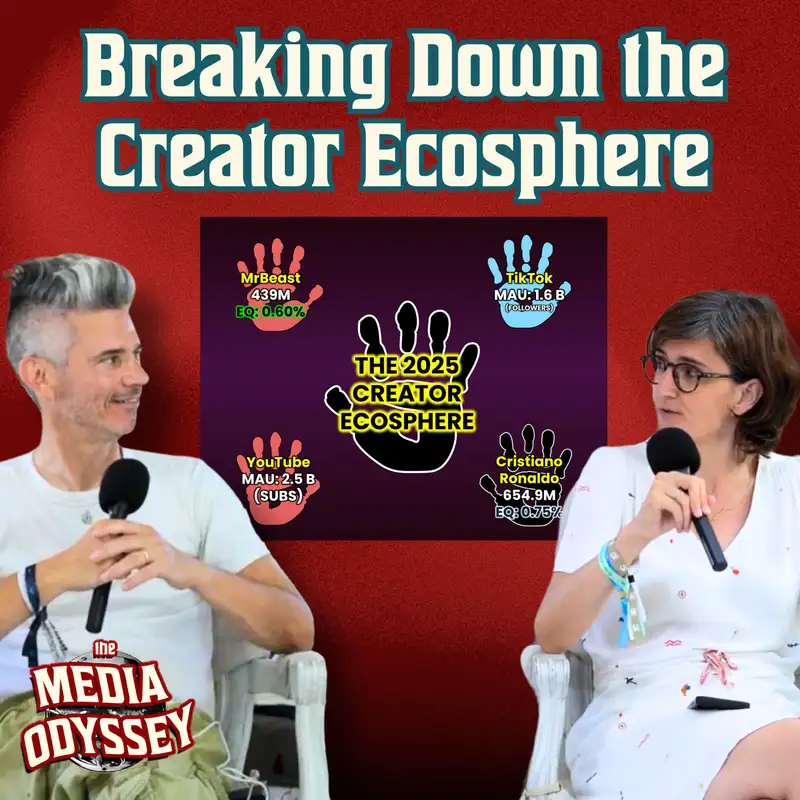
Evan Shapiro: Yeah, I think if you go into TikTok, which is one an area, Paul, if you can zoom in there. You can see what we wanted to go a layer deeper than just the vanity metrics of followers.
So if you look at yeah, this is a great one. So if you look at TikTok, you'll see the pure vanity metrics. 1.6 billion monthly average users.
And we use those vanity metrics, [00:06:00] which I think are much more a holdover of the last era of social media because we have to scale the platforms next to each other.
You can see TikTok versus Snapchat on the screen there right now. So that's a useful sizing of the, just the universe itself.
And then on the platforms, we scaled individual creators like Charlie D'Amelio and Khabane Lame by their follower accounts. Again, vanity metrics, just to show you the total addressable audience for each one of those creators.
But when you look a little bit closer, you can see there underneath Billie Eilish, she has an EQ of 9.1% under Lame. Khabane Lame's engagement metric engagement quality is 0.23%. Less than one quarter of 1% of his followers engage in his content on a monthly basis. And this is for the 30 days ending September 18th, whereas Billie Eilish 9.1%, which is off the charts engagement.
Ultimately, even though Khabane [00:07:00] has more followers, way more followers, more people activate, more humans actually activate when Billie Eilish publishes something to her fan base. Because they're much a higher engaged because of the quality of the engagement there than Khabane Lame's does. So you can spend for reach there, but you're not getting that many people engaging.
And to me, these affinity metrics, these affinity indices, are going to be increasingly important so that you can avoid spending on waste. You can look at Will Smith here. His engagement is red because it's less than one 10th of 1% engagement. I think when you look at the red areas on this map, you can see the difference between the green areas and the red areas is the difference between followers and fans.
And I think you can begin to see follower accounts that are either bought or bots.
Marion Ranchet: Yeah.
Evan Shapiro: I think that becomes very evident when you look at the EQ on these map, on this map.
Marion Ranchet: Can I ask you something about engagement? What does that mean? Is it a like, is it a comment? Is it [00:08:00] watching a piece of content?
Evan Shapiro: It is different on each platform, but it is a combination of likes, shares, posts comments, reposts on, so for on YouTube, it's different than it is on TikTok, but it is total engagements against the total fan base.
So yes, there are gonna be some pure likes and more passive engagements, then comments and shares. But these things are taken together and you can see where frankly, the empty follower accounts are. And then the real fandoms are as well.
When you look at Instagram, if you scroll over to Instagram really quickly, Nat Geo has one of the highest follower accounts on there.
It's down in the lower right hand corner of Instagram, but their engagement is lower than average. Average for a big brand or a big celebrity on Instagram is around a quarter of percent. So even though I derided a quarter of a percent engagement a couple of seconds ago, it's pretty average for large creators.
Then you look at Christiano Ronaldo, who not only has the largest follower account on Instagram and probably the largest [00:09:00] follower account across all platforms of anybody out there has a three times better than average engagement, quality 0.75%.
And over here you can see how powerful Taylor Swift is. Yes, she has far fewer followers than the Rock. Far fewer. The Rock has more than a hundred million more followers, but his engagement is very low, which is why his movie didn't open big this past weekend.
You look at Taylor's, which is way above average, 10 times average actually, and you can see the results when she drops an album, everybody listens to it.
Everybody stops what they're doing that weekend and listens to her album because she just doesn't have followers. She doesn't buy them. They're not bots, they're not artificial. They are earned.
Marion Ranchet: So I think there's a few things there. Something that you haven't mentioned, but I saw that what you are looking in terms of that engagement metric, you're looking at the last 30 days, is that correct?
Evan Shapiro: The last 30 days collected to this map and it rolls forward. So we did look at [00:10:00] it for, over the course of the summer to track. See if these are directionally correct. And they are, let's put it way more directionally correct than sweeps ratings are to television in the US and so you have to take everything with a grain of salt.
But Influencer Marketing.AI is a division of Stag. This is a data driven company. This platform is incredibly sound and you can check out their data yourself. We dug into it very deeply. We believe that these are good reflections of fandoms versus follower counts, to be honest with you.
Marion Ranchet: I think there's one thing regarding the EQ is that, so what I've noticed, and maybe we can take a look at YouTube. Very often on YouTube, you look at channels and they have a crazy number of subscribers. And most of them have joined in the first few years of YouTube, where, at a time where they were able to easily clock a lot of views.
And I think there's a, there's something there also to say on. Those who are in green, most likely are those who [00:11:00] have been staying consistent.
Evan Shapiro: Correct.
Marion Ranchet: Because there's a topic of consistency. That's why sometimes you have that lag, right? Between the number of followers, subscribers, and that EQ, it could just be that a lot of those platforms are publishing less, not publishing anymore, et cetera, et cetera. I've looked up at a couple of channel these last few days, and some of them have stopped these last few months. I think a lot of companies are also rethinking their strategy, or they've found more success in one platform versus another.
So that's where I'd say perhaps the EQ looks, I'm sure it's, spot on. But I think to explain sometimes that big gap, and especially with the big corporates, so you mentioned Nat Geo, ESPN, a few of those, it could be that they're just not doing their job.
Whereas pure creators, it is their bread and butter. They rely on those platforms and therefore they put content out there, every single week if they can. Whereas the big media guys, [00:12:00] a lot of them are still treating a lot of those platforms as
Evan Shapiro: Marketing. Purely marketing,
Marion Ranchet: I wouldn't say, yeah. Marketing, Afterthought.
Evan Shapiro: That's why they, that's why you don't see that many brands. ESPN pops in here, but you look at their engagement, it's very low.
Nike is big on Instagram. Their engagement is very low.
Marion Ranchet: Yeah.
Evan Shapiro: But you're absolutely right. When you look at YouTube and the engagement quality here, first of all, just given how the average engagement on YouTube is substantially lower than it is on Instagram and TikTok.
So it's average is around 0.1%. So one 10th of 1%. So just set your expectations around that.
That's why Mr. Beast at 0.6% that's very high engagement for the biggest audience on YouTube, that's extremely high.
The problem with this is the kids' stuff is harder 'cause a lot of the engagement is not turned on those channels. And so it's just not applicable for things like Coco Melon and some of these other platforms that are out there. Baby Shark.
These are huge kids channels, but we don't have engagement quality there. That said, I think when you [00:13:00] look at hours viewed on these platforms, it's humongous. And I think that is a good demonstration of it.
And since a lot of them are not ad-based, there's not a real incentive to create empty calories of views there, mostly that's just around merchandising.
But if you look at T Series and some of these other huge channels on YouTube in particular, you see a lot of, Warner Music and Wave Music, I'm sorry. In particular here, Z Music in particular, their engagement rates are low.
They've been on this platform for a very long period of time, and a lot of their audience is simply, I think, bought or it's just stale because subscribers don't unsubscribe necessarily. They stay subscribed. So the subscriber counts get very high.
But you look at something like Stokes Twins, which has 131 million subscribers. Twice, almost three times average engagement rate. You can see why that's a business for them. They are probably doing well through ads, but additionally with that kind of engagement, they're probably selling [00:14:00] their own products.
They're probably, they probably have many other elements on their flywheel. When you look at Mr. Beast, his engagement quality isn't just proof of fandom, it's proof of another business. He is asking them to do other things and they're doing those other things. And for him, that's gonna be launching a mobile company soon.
So engagement means something very different today than it did when Mr. Beast started, or when the Paul Brothers were making Vines.
Marion Ranchet: Yeah. What's fascinating is that when you look at this map as a whole, right? So this is the year where the creator economy, creator media became mainstream, right?
Shira, she's been, focused and dedicated to this for years, and most likely she was part of those companies and folks who were educating the rest of us, so to say. There's one thing that I've noticed this year is that a lot of, there's a lot of pushback on the actual power of the creator economy because we're being flashed all of those big numbers of followers.
And what's interesting with the map is [00:15:00] that, so it says two things. We knew right, that as always, a subset of channels and accounts on all of these platforms were very were actually big and could make a living out of this.
But when we look at your map and we see and look at the EQ, then that's fascinating because that means that all of those companies that have a low EQ, most likely they're struggling to monetize. And they're not good bets for advertisers to invest in. So I think it's a,
Evan Shapiro: that would be my
Marion Ranchet: It's fascinating.
Evan Shapiro: That would be my argument. I also think for example we tried to cover things that are not usually covered in creator economy lifts. So the podcasting area Paul, if you zoom in there, and for those who are listening, please go to my Substack or Shira's article on the map is really complete. Lots of analysis, deep dive into each area.
But podcasts, is a creator based platform. Yeah. We're doing one right now and we both [00:16:00] consider ourselves creators. It's actually a core element of it, and I'll show you two reasons why. First of all, there's a half a billion people over a half a billion people on Earth who listen to podcasts.
I actually think there's far more than that. But when you look at where the active audience is going, YouTube is much larger than Spotify. And Spotify is much larger than Apple. Then when you look at iHeart, they have the most active listeners on podcasts on Earth.
But the New York Times with far fewer shows, probably less than 10% as many shows. The New York Times has almost as many listeners on an ongoing basis, and I would argue their podcasts are substantially more influential than the traditional ones out there.
And then you can look on the right hand side, The Daily, their podcast is the number one podcast on this list in that given month.
Now, if you go to the other end of the map completely to the Patreon side of it. You'll see that there are follower accounts there. Matt and Shane's Secret Podcast. So a podcast as creators. A [00:17:00] lot of podcasts on this list. They, the most paid subscribers is 123,000. 72,000. They're generating millions and millions of dollars a year in bespoke subscriptions here on a new, on a new platform.
It's not new platform, but for a lot of people it's not necessarily central when people have these conversations around the creator economy.
So we tried to create not just a comparative study amongst the various platforms themselves, but then other aspects of the creator economy that not everybody takes into account, especially now when the creator economy means so many different things.
It's a huge marketing platform, but subscriptions and community and those types of, and merchandise and live performance and all other spokes off the hub of the flywheel really matter. The creator economy empowers that. It creates a connection to a community and to a fan base that you can activate in other areas of your business.
Marion Ranchet: I will say that when I saw this, I [00:18:00] saw the Patreon numbers first, and I thought that there's a glass ceiling on all of this. It's the 10% rule between free versus paid.
If you look at Substack, it's the same. 15 million monthly active users, only 5 million paid. I don't know if it's subscribers that you included or subscriptions.
Is it?
Evan Shapiro: For sub? Yeah. So it's 5 million subscriptions. The, and that's what they say that is their number. So that's a, there's an example that doesn't go from, come from a source that came from their own report with the monthly average users being 50 million. There are, there I, how many actual paid subscribers are out there?
These are total, these are total subscribers. Paid and unpaid.
Marion Ranchet: Yeah. But so this week let's talk about Substack and creator media. Bari Weiss, former New York Times now Free Press with Substack 1.5 million subscribers, total, I think 150 paid. So it's always that 10% [00:19:00] rule. So what I'm saying here is.
Evan Shapiro: And how much did she just sell, zoom back out, Paul.
Yeah so yeah, and I think she just sell that to
Marion Ranchet: 150, completely
Evan Shapiro: $150 million, and now she's running CBS News, and there's a chance that she'll also be running CNN at some time in the near future. In addition, that same organization is probably gonna control TikTok in the very near future, so that casts a very different light on this map.
To your point, that tiny little area, Substack all the way up there in the upper left hand corner of this map that is insignificant is now gonna be one of the most important sources of thought for the mainstream media.
That's really, I think what we have to realize here simultaneously, Mr. Beast, the largest and by the way, Bari was one of the largest publishers on Substack. She was a leader on that platform.
Mr. Beast got a hundred million dollars from Amazon and he's the biggest creator on YouTube and one of the bigger creators on TikTok. You [00:20:00] can look around, Taylor Swift when you look at this map, it's not surprising how well she does in the music economy, given the following she has across platform and the engagement quality that she has everywhere she goes.
Billie Eilish is another one that just amazing off the charts engagement quality. Yeah, so I, I think you can start to predict where the market is going by looking some of the, at a combination of things.
One, look at the largest creators on this map. Look at their engagement quality, and then look at other market indicators like Netflix paying Ms. Rachel to get her show and the Sideman. You'll see other market indicators. Based on this data as well.
Marion Ranchet: So I think what's clear here is that, any of those accounts, they are personality led, right?
It's, yes, there's potentially a brand name, so there's the Free Press, but a lot of these are people. Very much embodying their business. That's the new brand of the [00:21:00] 21st century, so to say.
I think that tomorrow if I'm gone, everything I've built is gone. So I think in here, what's fascinating is to see that the big, the big next new companies could be coming from this versus purely standalone, very corporate companies, that aren't led by this one founder. It's a very founder led ecosystem that we're in.
Evan Shapiro: I just say I, I'm gonna disagree with you to a certain extent, you're right to date, but that's largely because to be blunt, the biggest publishers, the corporate publishers, the corporate creators out there have avoided putting their content on here.
I'll give you a good example of how brands are really crushing it in this ecosphere. If you can zoom in on TikTok for me, Paul, if you're following at home on ears zoom into TikTok. When you look here, some of the highest engagement quality and some of the most fervent follower accounts are for regional Champions League.
Going to one of your favorite things here.
Marion Ranchet: The club, yeah. [00:22:00] Yeah. I see Barcelona, Madrid.
Evan Shapiro: ESP.
Marion Ranchet: Yeah.
Evan Shapiro: Parris St. Germaine.
Marion Ranchet: Yeah.
Evan Shapiro: Really decent above average engagement quality. And then look right below Paris St. Germaine. So they have almost 50 million followers on TikTok. They have an almost 0.3 engagement quality. Then look right below it. ESPN has more followers, but a fraction, one third, the engagement quality.
There is a great comparative study on how brands can and shouldn't try to activate on social media. When you look at some of the highest engagement stuff on this map you will see very high engagement for teams and certain leagues as well.
If you go up to Facebook though, which by the way, I think a lot of people sleep on. So for video in particular, and if you're a lot, if you have a good creator who creates a lot of video or owns a lot of video, YouTube is the number one place to monetize. There's no question about it. TikTok is hard to monetize on, to be honest with you. Unless you've got great brand deals that you're [00:23:00] doing.
Facebook is quietly the best place to after YouTube to monetize your video content. And when you look here at who the leaders are, Harry Potter, McDonald's, Netflix, Mr. Bean, a lot of Chinese companies, Coca-Cola, Facebook, Samsung, Meta, YouTube, will Smith again.
Marion Ranchet: How come you don't have EQ on these is there?
Evan Shapiro: This was a more complicated metric to do on this one. So we're working on this. We have EQ, if you go next to Twitch here you see we have a different version of EQ here, which is hours viewed.
So you, shows you the follower account and then it shows you the hours viewed in the previous 30 days for this.
So we're still working on the EQ as a metric. We have it for four major platforms. We don't have it for for Facebook yet, but we will. And we're gonna be reversing this at least once a quarter.
Marion Ranchet: Yeah, I just to go back to what you said, so yeah, I see what you mean. So I said it's very personality led, I think you said it's, in a way, it's, it can be brand or brand led or, passion led.
Yeah. Big media, [00:24:00] they have a shot at this, but the only thing that I will say is the challenge they have is that they can do that with IP, but they can't really do that just as a brand. There's gonna be a few exceptions, but I tend to believe that corporate side of thing, that builds followers, that doesn't necessarily build.
Evan Shapiro: I think there'll be exceptions to that.
I think Netflix is proving that and they have very big, not highly engaged always, but they have very big follower accounts on most of the social platforms. Let's Disney, Disney would be another one that I would imagine would do very well as is, but they don't really engage. Disney does not engage not for their individual brands all that much and not so much for their brand and their platforms writ large.
Mostly it's marketing on their platforms.
Now, they just did hire someone from YouTube in their marketing team. So that might change. And I do believe if you zoom back out, Paul, and look at the whole map, and if you're following at home, zoom back out.
Imagine if Disney and [00:25:00] Warner in particular, and let's call it the full scale of all public broadcasters on Earth all leaned into this ecosphere for the next decade. Very hard and heavy. Not just marketing, but programming, distributing, building fandom here for, to your point, individual programs like Coco Mellon or Bluey or Dr. Who. Or for the platforms themselves or other elements. I think this map changes its entire shape.
Marion Ranchet: Yeah.
Evan Shapiro: I think the creators are leading this map today individually, which is demonstrated here because that's who's been running it up until this point.
Marion Ranchet: Yeah, and they're first in.
Evan Shapiro: Correct. And then eventually when Disney decides to lean into this ecosphere, the shape of it will change. There is no question about that.
Marion Ranchet: I noticed a couple of things missing. I was thinking about WhatsApp with WhatsApp Channels. So a lot of those brands you've mentioned here, they actually have a WhatsApp channel, so
Evan Shapiro: You're right.
Marion Ranchet: I'd love to see that. [00:26:00] Yeah.
Evan Shapiro: We I mean we, we did debate WhatsApp. We debated Reddit too a long time. We were also yesterday I was told from someone, from Disney interestingly enough that Roblox should be on here. Minecraft should be on here. Fortnite should be on here.
Marion Ranchet: Discord. Discord should be on here. If you have Reddit...
Evan Shapiro: Discord is on there. Discord is on the is on the tools. So if you go into the upper right hand corner here and again, there is, I'm not saying there is not subjectivity.
Marion Ranchet: Yeah.
Evan Shapiro: But in particular, thank you, Paul. So it's under community in the upper right hand corner for those who are following at home.
There's a green area, but the pink are for community there. WhatsApp is there as well. So we see them as community building tools that sit alongside the communities. Now people do have channels there that are very active, but they're not, they're not follower. They don't seem to be fandoms in the same vein, but we will continue to look at those.
I do think people who make games on [00:27:00] Roblox deserve to be treated as creators as much. Spotify very much once they have said to us. They very much want their own space on here to measure the individual artists there.
We did represent them down below. We'll see how they feel about coming in second place to YouTube.
But this is meant to be a conversation. So if you have comments please go to the comments on this episode of the podcast and drop your comments here. Feel free to drop them on my Substack, on Marion's Substack on What's Trending's piece about this. Hollywood Reporter also dropped this map yesterday.
And tell us what you'll change if you, Marion, you know this very well, I have changed the original map endlessly. Month by month. Very much in comments you've made to me, and then comments that other people have made in the comment section of the maps and of the podcast and things like that.
Marion Ranchet: Yeah, that's, I think I have to say, not that I really like paying you compliments.
Evan Shapiro: Oh yeah?
Marion Ranchet: Because you [00:28:00] have enough of that coming your way. But I have to say that the fact that it's very much open to everyone, iterative, and especially I feel like that, I'm sure a lot are feeling like that too, is that everything is so expensive right now when it comes to data and insights.
When it's actually the most interesting thing. We should have access to more data because that's when we can do all of us actually we can brainstorm and improve and et cetera. And so I love the fact that it's out there and that you are kind of, well you are a creator, so you are, building it with your community.
You are really very much walking the talk. That takes us to the question of the week though.
Evan Shapiro: Yeah. Okay.
Marion Ranchet: When you look at this. There's a bit of a sense of panic because there's so many places where you can actually meet your audience, build your audience, build fandom, et cetera.
So in your opinion, what is the best social platform for growing an audience today and why?
Evan Shapiro: I cannot answer that question. I think the answer is [00:29:00] in the asking of the question itself. The reason why we wanted to put all this information, including the tools. And then on the left hand side there, you'll see distributors, aggregators, you'll see agencies listed.
The reason why we wanted to put this all in one place is that there is no one size fits all. There just isn't.
I would say that if you wanna have a media or intellectual property based business on a moving forward basis, you're probably gonna have to be on most, if not all of these. Which includes Reddit and Discord and Twitch and Substack.
Maybe not all for everybody and that's really where it comes into play. Like also, do you build your own app or do you only rely on other people's apps?
There's a whole, like I said, gaming section that could be on here. So it's gonna be different for everybody. What this map really wants to do is help you ask the right questions.
So you can see on here like-minded brands succeeding on various platforms. That's a good place to start. Look at the ones that actually have active [00:30:00] fan bases on these platforms. That's another way to go about it, but I think starting with who your audience is and what it is that they do and what it is that they love is always going to be at the center of any successful creator endeavor.
And we hope that this map allows you to start asking the right questions. And then you can go to some of the sources on here, you know yourself and get a lot of the answers yourself. But it very often businesses in the creator economy and in the traditional media economy are simply not asking the right questions.
Marion Ranchet: So I agree with everything you said, unfortunately because yeah, that's annoying.
So one thing that I'm seeing, I agree with doing bottom up. Where is your audience, target audience and you start there. I will say that it is very difficult to be good at everything.
So my thing would be the rule of three maybe, which would be whatever you're trying to do, [00:31:00] you peak maybe three platforms. And so for example, for media companies, I would say let's look at us right from a B2B perspective. You need to master LinkedIn. That's your discovery platform. Substack, because that's the next level of relationship engagement with your audience, because you have their email, you are popping up in their inbox every day.
And then, youTube slash podcast. I'm putting the two together because as we've seen, YouTube is a very strong podcasting platform. But when you do those three things together, I think you are unstoppable. And I think both you and I, this is what we've done, right? We've chosen carefully where to be at.
I don't need to be on Instagram and Facebook given what I do, but someone else will.
I agree.
Evan Shapiro: And that's where I would throw in the folks on the ESAP side are working on a project with Filmhub called Skit. Which is a creator led film about creators. We made it for $65,000. We're distributing it with a partner, an aggregator in this ecosphere Filmhub [00:32:00] through across AVOD and TVOD.
We're starting with an exclusive window on Tubi, which is gonna help us get out there, but the idea is this is completely new use of the creator sphere. For a lot of people listening to this podcast. That said, Filmhub distributes 500 films a month that way, and so there are various elements in here. One of the other reasons you looked at this very much through the lens of a creator yourself, right?
A lot of the people who listen to this aren't creators. They're executives, they're lawyers, they're finance people, they're marketing people, they're salespeople. The list of companies on here, the Mr. Beasts of the world in particular, and the other Messi is gonna build a media enterprise around him at some point. There's no question about it.
Those are good brands to get aligned with. And a lot of them have their own companies. Jake Paul, Mr. Beast, but also look on the left hand side here, Dropout. Mythical society. There are a lot of really good companies, [00:33:00] Whalar, Filmhub, Totem, Little Dot Studios, Merzigo. There are a lot of great companies operating on this side of the creator economy where there are going to be good jobs because that's where the money is going. That's where the money is flowing.
Look at Dropout in particular, or First We Feast, both studios completely independent of the Hollywood system, who have been very successful in the creator economy with very different models than a lot of other people on this map.
They didn't make the largest follower accounts on any of the platforms, but First We Feast just sold for what? 90 million, $83 million or something like that.
And Dropout is about, has a very successful SVOD business and is getting into the FAST business as well. Really good examples of people who are leading the industry through example and growth is going to, but not through the way that you would normally think.
Marion Ranchet: Yeah. So this is actually also an employment map, on your next
Evan Shapiro: Yes, that's exactly right.
Marion Ranchet: Yeah. No, but [00:34:00] what I think I actually, what I like here is, which you don't do necessarily on your media map, traditional media map, is you see the studios, the IP manager, the agents, et cetera the technology.
And of course, no one did you know any of this on its own, right? It takes a village to build creator businesses. I think there was
Evan Shapiro: That's exactly right. Yeah. I think everybody thinks that you can do it all by yourself, but more and more why would you try to do something that somebody does at scale to be blunt.
And that, and, that's why we use Substack. That's why we use Riverside. That's, these are great tools and great examples. And that list. Please, if you have examples that are missing from this list, please send them to us. We tried to be as thorough as we possibly could and provide platforms and tools and agencies and studios that are operational, that are reliable and trustworthy.
Marion Ranchet: I love it. Cool. That takes us to the end of this episode. Fantastic. So
Evan Shapiro: Thank you for doing this.
Marion Ranchet: Yeah, no, it's been it's been good fun. You are giving [00:35:00] us food for thoughts. I love that.
Evan Shapiro: So that's the end of this episode. Thanks for listening to or watching this episode. The next two episodes we recorded at MIPCOM, and they also focused on the creator economy.
Marion Ranchet: It's a full months of creator media with The Media Odyssey podcast. And so we're gonna have the team from Filmhub and then Whalar and actually can't wait to see their take on the map itself. I know you've done this one with Filmhub, but excited to get their take on how they see this ecosystem.
Evan Shapiro: I, there was debate between us and Filmhub of what to include, so we can talk about that and I'm really interested in Jon Goss and Whalar's take and lighthouse's take on the map as well.
Marion Ranchet: Fantastic. So that's it for today, right?
Evan Shapiro: That is Marion Ranchet.
Marion Ranchet: That is Evan Shapiro,
Evan Shapiro: Please like, subscribe, share this podcast with those you love because it's a great podcast.
It's your Media Insider's Insider podcast.
Marion Ranchet: Yes. Boost our EQ, right?
Evan Shapiro: That's right. We need more EQ. Thanks so much. We'll get you next time on The Media Odyssey [00:36:00] Podcast.
Creators and Guests