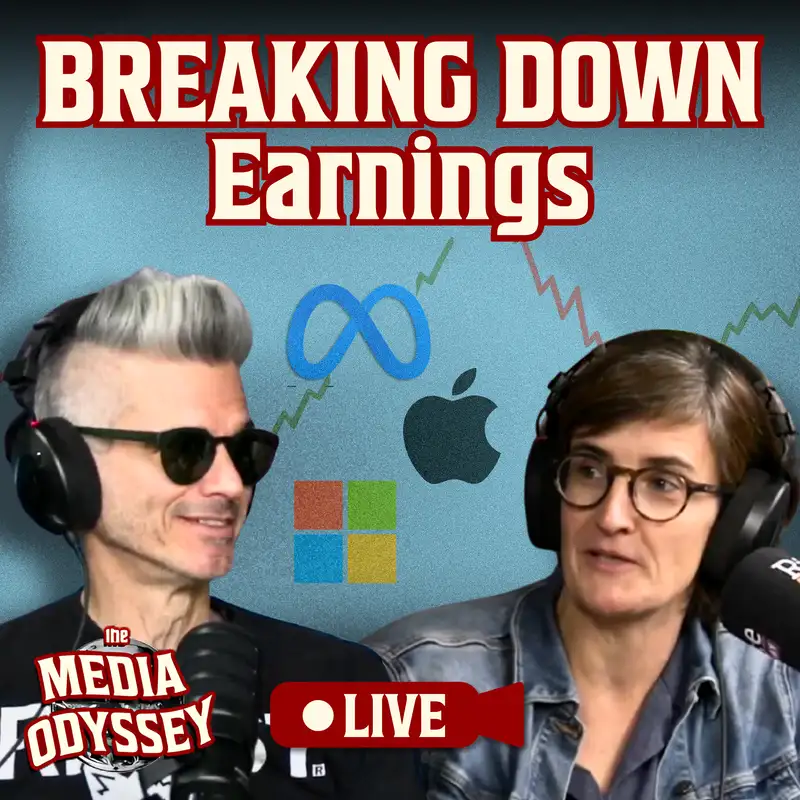
APPLE, META, & MICROSOFT EARNINGS BREAKDOWN
Download MP31_30 - Apple, Meta, & Microsoft Earnings
Marion: [00:00:00] Hey, man.
Evan: Hey, how are you, Marion?
Marion: I'm good. I'm good. This is our second live session. I'm loving this already.
Evan: Yeah, this is, so, the first time we were remote in London. Now we are across the sea as our show usually is. Welcome to the Media Odyssey live stream on YouTube and LinkedIn. Those of you who are on either-- Hi, welcome.
We'll be taking questions. Do post them please, in a little bit. We�re going to banter here for two seconds because what are we doing Marion this morning?
Marion: So this morning we're breaking down Apple, Meta, Microsoft, and we may have an extra one that we're going to throw, uh, into this thing.
Evan: Uh, yes, one of my alma mater.
So in the last week, we've had earnings from some of the biggest companies in the history of the world, including Meta, Microsoft, Apple. Why don't we go ahead and, and, and jump right in. Let�s start with the, the behaviors of the stock, since, [00:01:00], these earnings came out as of this morning, and this is not real time, but Meta is up.
Uh, you know, not double digits, but, but up generally. Comcast is up, Apple is either flat or a little bit down, and Microsoft is down. And we're going to be talking about why the market reacted to each one of these different, uh, companies� earnings, differently, and sometimes given the same information, they reacted differently to two different companies.
So do you wanna jump in and start? Where do you wanna start?
Marion: Let's start with Apple. Okay.
Evan: That was, so, that's the most recent. That was just yesterday. Your takeaway on, uh, Apple's earnings.
Marion: So I was, I thought the results would be, uh, not as good as that, I have to say. Okay. So I was actually surprised, right, because if you look at revenues, up 16%, [00:02:00] across the boards both, you know, service, revenues and product revenues are up. I don't know, for some reason I thought that, you know, with this whole deal with Google on, you know, uh, Gemini and also the fact that they've been under, you know, a lot of pressure when it comes to, uh, chip and the sourcing and the whole supply. I thought we, we'd had, you know, uh, worse numbers than that.
So I was actually surprised, happily surprised. What, what was your take?
Evan: Same, I wouldn't say happily surprised. I was just surprised. The thing to know about Apple's earnings though, is they were entirely driven by one word,
Marion: iPhone.
Evan: iPhone entirely driven by iPhone. The only reason Apple had a surprisingly good fourth quarter, uh, earnings report is because the iPhone surprised people.
There was more demand for it than anyone [00:03:00] anticipated.
Marion: Yeah
Evan: Because if you look at the performance of it year on year for this decade, it's the best year they've had since 2021, which is post COVID and, and people breaking out. Um, it's the first time iPhone sales have grown. Year on year in four years.
Marion: Yeah.
Evan: So it's a real break against trend. So that's a good story for them. But there's two nuances to that. The first is most, if not all of the increased demand came from China, which is not a market that's gonna recycle its phones year after year after year. So, and they're just announced negative population growth for the first time.
So that's a little precarious. And then secondarily, we are still at a time, all these years of services growth. And you can talk about the services growth 'cause that's where the interesting growth at Apple is. That's where the innovation is happening. But still, iPhones represent 52% of all Apple revenue in [00:04:00] 2025.
That's precarious for a company that's built on innovation.
Marion: Yeah, absolutely. And, and, and knowing that, uh, we live in a bubble and I have an iPhone, you have one. But if you look, you know, on the global stage, three out of four, uh, devices right, are actually running under androids, right? So, it feels like, and it's been that number for many years, so it feels like there's that glass ceiling for them.
And they shared the number of, uh, active devices, right? So 2- 5 billion, I believe.
Evan: Yeah, that's correct.
Marion: I think this is
Evan: compared to 7 billion. Closer to 7 billion for, for Android? Yeah. It's a, it's a, but their big growth and their big profit comes from the services revenue. So not just subscriptions to Apple One or uh, Apple TV Plus and all that kind of stuff, but Google pays them $20 billion a year.
To be the search default [00:05:00] on iPhones that's in the services revenue. So it's an interest, there is growth there, but it is not catching, it is not taking over as a truly diversified company. And that troubles me. I think Tim Apple buys himself a little time with these results, but I, I don't think this is a company that's innovating or growing really based on these, this report.
Marion: If you look at the service segment, yes, it has doubled in five years. We're beyond, uh, a hundred, uh, billion. Right? Right. Um, so the question now, uh, no, we're a hundred million.
Evan: Subscribers. You mean users?
Marion: The service revenue. Uh, I think we went beyond a hundred. A hundred, but I can't remember if it's, uh, billions. Uh
Evan: So in fourth quarter, 2025, they did 64 billion in, in revenue, right? That's Yeah. Oh, no, no. I'm sorry. No, no. That is, uh, Microsoft. I apologize. I apologize. Mm-hmm. So in [00:06:00] fourth quarter, services revenue was 30 billion. And for the year, the services was 109 billion.
Yes. The first time over. First time over a hundred billion. You are correct.
Marion: So that was, yeah, I was in, I was a hundred percent sure. But, so if you look at as doubled, but we're looking at what, uh, around 13, 14%. 13%.
Evan: Yeah. 13%,
Marion: Right? So very far from those, you know, initial days where they were closer to 16, et cetera.
And so that says a few things, right? If you look at the innovation piece, the, the, yes, they're, they have the iPhone. This is that device that they're pushing every year. But Mac cells down, Wearables down, uh, the, are making no moves whatsoever, uh, on the big screen. And to me, that is still, you know, a big question mark on, on why.
Why they're not investing more, uh, with the, with the living room.
Evan: Even their cloud business is not really a business, it's just an add-on. Right. And let's pivot to the, to a comparable company another now the, one of the largest [00:07:00] companies in the history of mankind, Microsoft. They have, you, you, you were talking about before we got on AI, Apple's lack of AI strategy.
They're buying their AI from Google, and we'll get Google's earnings next week, I believe. Um, but in Microsoft, they're plowing money into AI and they're showing a return, 28% growth just on their cloud business, which is an AI business now, and yet they get punished day on day for their earnings report.
Total revenue for the the quarter was up 16%. Net income was up 60%, 59.5%. And yet compared to Apple and Meta-- Apple's, overall performance was good, but it wasn't spectacular. Total net income up 16%, total net sales up 16%. So why is Apple being celebrated and Microsoft is being punished?
Marion: I think there's a few things, right?
So if you look at Microsoft, it is a very [00:08:00] much a portfolio business. And so when you look, uh, at cloud, yes, it went beyond the $50 billion. But I think I've read that, you know, there's a lot of disappointment, so to say as to, you know, co-pilot and their ability to actually transform all of those AI investments into actual revenue.
There's also to me, and I'd be interested to understand what you, how you feel about that. I think their investment in OpenAI is, is actually gonna become a liability. They were the first to jump on, I think they have around 20, 27%.
Evan: Yeah.
Marion: Of capital, uh, at OpenAI. They get a cut on whatever OpenAI is making.
However, we all know that, you know, between what they're spending and what they're making. A hole-- it's a massive sinkhole. So I think there's a bit of liability there. And also, [00:09:00] I've read a few, uh, tech commentators and, and, and they feel like they're not moving fast enough on that front.
So spending a lot of money but not moving fast enough, and especially not transforming how the take up, uh, of, uh, you know, AI driven products, uh, within their portfolio.
Evan: So, that�s the thing is okay, you're right, they are overly bought into the AI bubble hype.
Marion: Yeah.
Evan: Um, and specifically into open AI itself.
And Open AI is at the center of this circular economy. They don't have the math to make their subscription business work. They are taking in investment from Nvidia and from Microsoft. Microsoft owns a huge part of them and then guaranteeing revenue back to those other companies. And when that [00:10:00] business model doesn't add up three years from now, the whole thing begins to fall apart.
The only thing I would change that I would disagree with you on is Microsoft is proving that AI is a profitable business for them. So Nadella himself said we are only at the beginning phases of AI diffusion and its impact on our company. And our AI business is already larger than a lot of our existing franchises.
So they're already seeing returns on investment. Internally there, either by cost savings internally, but more accurately the stickiness of their office products and crucially, their cloud and infrastructure business, which is enormously profitable because they've already built it. It's to a certain extent sunk cost.
They're continuing to build it, and they're continuing to invest in it, and that's why they're being whacked by the market is because they're really highly investing. But again, if you look at their total revenue growth, 15% great. Their net income growth year on year [00:11:00] for the total year was up 15% and up 60% in fourth quarter.
So they, like Meta, like Google, I think have the appropriate application of AI, which is internally in a huge organization that's already using it to maximize revenue in advertising. Note what OpenAI announced last week. An ad business, that's because they're seeing what Google is doing with their ad business and Microsoft is seeing as well.
So I still don't understand why Microsoft is being punished by the market when Apple doesn't have an AI strategy. And Meta is doing basically the same thing. We'll talk about Meta in a second.
Marion: So, they�ve lost what, the stock went down 10% and that's like over 300 billion lost in valuation.
It's true that it's enormous. Speaking about Apple, just a quick thing. 'Cause I've been thinking, we chatted right about the fact that they are lagging [00:12:00] behind and they've decided that they're not in the business of doing what, you know, Google and, uh, and Meta and Microsoft are doing, which is to essentially build infrastructure.
And one of the reasons is that, you know, what they need is that they want AI on their devices. And they don't, and for that they don't need to have what the others, you know, are building. So in a way, licensing, borrowing, you know, uh, what others are. They've spent what, a billion, uh, back to Google for this.
I think I'm, I'm thinking. More and more now, in initially it was like they're late to the game. I'm thinking more and more that it is a cautious move because in any case, uh, what they wanna do with AI is relating to devices. 'cause that their core business, you've said it, 52% goes to iPhone sales, therefore.
No interest in building all of that themselves would be way too expensive to, uh, to, to do that themselves. They would need to go to all of those companies to use the cloud infrastructure. I think the, the business case would [00:13:00] not work, and ultimately for a limited use case that is, uh, AI on device.
Evan: Yeah, I, I agree with you.
But the, the, the, the problem is, let, let's put AI aside for a second. So, as I said, AI is only gonna be valuable, not as a standard. You don't pay for email, you don't pay for search, and that's where AI is going. It's gonna be your email and your search, or your, your agent to a certain extent, but it's very rarely gonna be paid for bespoke as its own subscription.
It's gonna come in a bundle with Google shit or Microsoft shit. We're Apple shit and there's a real argument to be made. Don't rent it, build it. But let's put AI aside. What Apple is failing to do is building out its other potential revenue streams. It still doesn't have an advertising business.
Marion: Yeah. Yes.
Evan: How is that fucking possible? Yeah, so Apple's entire business is selling phones to rich people. We, we talked about the market share. So Apple has 35% market share. Android has 65% market share for operating system. That's [00:14:00] because Apple has chosen to. Only sell very expensive devices to very rich people, period.
That's their, that's their strategy and their app sales. They, they represent 65% of app sales on Earth, only 35% of phones, 65% of app sales. That's because they sell to rich people. The advertising business would be just as disproportionate. They would get higher CPMs because of the, the effectiveness of their environment and the quality of their audience.
They would have an amazing ad business if they fucking built one. you have one. Yeah
Marion: They have one.
Evan: Do they really though?
Marion: Well, the, the challenge we spoke about the service segment and as much as I love that segment, we don't know what's in it, right?
Evan: Advertising would be in there, but it's not really growing that much.
Marion: Well, it's in there and, but we have no clue. Just like the rest on we, how big it is and whether it's growing, uh, yes or no. Um, but uh, I'll link to a piece 'cause I did an article on their advertising business. But I have to say that, you know, until they [00:15:00] actually share any data on what they're doing. How well it's performing� it's, it's a bit moot to, so, I, I agree with you.
If we, uh, switch gears to Microsoft-- one more thing. 'cause I know you've been very vocal about gaming, and I was very surprised to see that, you know, it was nowhere to be found. Yes. If you dig in. But was there any mention about, you know, Activision--
Evan: Yeah, thank you for asking. No not really, other than to kind of like, you know, walk away from the results in that, in that department. So their personal, they, you know, they have a very complex reporting structure. Also, these companies go on fiscal years, which are all outta whack. I'm usually talking about fourth quarter or full year, calendar year, 2025.
And their more personal computing division, which is where gaming and Xbox are, and Activision Blizzard, which they bought for 60, $70 billion and finally ingested last year. That revenue was down 2.8 [00:16:00] billion, 2.8% for the quarter. For the year, it was up 8%.So it wasn't that bad a story, but it talks about, there's actually a, it's, it's been a reckoning in gaming and in particular Microsoft has never, it's the third or fourth most popular console ever. It's never really been. In the major console wars with Nintendo and Sony in the way that it wants to be.
And now it's much more of a software. 70 plus percent of Activision's revenues comes from live gaming, not from console sales. And so you can still use a console to game that way, but it's not really where the industry is headed. So it does ask a lot of questions about that sector in particular. But if you look at this, I mean, this is a stock I think that will survive whatever bubble bursts in AI and at.
When it dips, buy this dip. I I, that I don't, don't take stock advice from me, but, uh, if I bought stock, that's what I would do.
Marion: So speaking about Meta, let's chat about Meta, [00:17:00] right? Very surprising to your point, the fact that they are spending a lot of money, even more so than Microsoft because they're in this playing catch up thing, right?
And so they, it did not impact their stock at all. So again, you know, what is your thing? Is it because Wall Street thinks that, you know, whatever Meta is spending, because there's, you know, advertising on the far end of that, then it's worth it because, so Apple this year, 12 billion spent on that front. Microsoft looking at 82. Meta, only 72, but they're saying that next year could grow between, uh, another a hundred fifteen, a hundred thirty five, which is like. Insane money. So what's your thinking about, you know, why, why that that business case potentially makes sense for Meta and, you know, not Microsoft, this case around. [00:18:00]
Evan: I don't know. I honestly think that Zuckerberg is a better salesperson than Nadella. It doesn't make any sense.
So their total revenue is up 24% for the fourth quarter. Uh, total revenue up 22% for the year. Fine. But they had a huge increase in expense in fourth quarter, like massive increase in fourth quarter, and now they're doubling down on expense in AI in particular this year. That was the announcement there.
Meanwhile, their net income grew less than 10%, 9.2%. And that's not an awesome story, especially when for the full calendar year, net income at Meta went down 3%. And it's not because revenue didn't grow, it's because expense outpaced revenue growth. That is a, that is a really fascinating story that got sold and the stock went up afterwards.
And I would argue that especially when you-- So all the [00:19:00] investment is going into AI. He senses the moment there. Congratulations for him. Meanwhile, revenue is growing and net income is growing. Separately, though in the same breath. Reality Labs, which has been this money pit for them over the last number of years lost $6 billion last year, and they're basically now shutting it down. So the last fantasy land that he built us. Remember when he changed the name of the company to Meta?
Marion: Yeah.
Evan: Woo. What happened to the Metaverse lab? That's Reality Labs. That is a, that is a money pit. It's a dumpster fire, and he's running away from it.
Meanwhile, net income at the company dropped 3% last year, and no one went after him on this. Last thing I'll say on this. He says, we're starting to see a project that used to require big teams now be accomplished by a single, very talented person. There are massive layoffs coming at that company, and that's why Wall Street applauded him because he said this, I have found the future of AI.
I'm gonna fire a shit ton of people [00:20:00] this year.
Marion: Reality Labs, we could have shut down this thing two years ago. Not even start this thing two years ago. Right? So how, how much? I think they spend like 19 billion and made 2 billion.
Evan: Something like that. Yeah, yeah, yeah. It�s a ridiculous, they, they lost a total of 6 billion over the course of last year.
And I think they're signaling that they're shutting that part of the company down. That a lot of the layoffs. Yeah, that's, that have been announced in that division.
Marion: So the only thing I have to say, but maybe that's me not knowing enough about AI, but I'm like, why? So are we saying that, all the business that Meta is running, advertising, uh, all of that needs AI to run properly. So, uh, I'm thinking, you know, ad targeting, uh, recommendation, all of those things, is that the reason why? And given that they do what they do, they need this thing to be, you know, proprietary. It needs to be theirs and not, you know, someone else's is, is that what we're saying?
Evan: That's all [00:21:00] Meta you're talking about?
Marion: Yeah.
Evan: So crucially, think about the, so they have Instagram, WhatsApp, Facebook, right? Yeah. Now Threads, which is out, bigger than Twitter. And think about the product, just the product, of those four different interfaces, and think about the engineering department of those interfaces.
Marion: Yeah.
Evan: The rated AI is going to be able to re-engineer those platforms in real time. Humans won't be able to accomplish it, and that's what he's literally talking about. There are other jobs as well that will be affected, but it's mostly in the coding, recoding, rebuilding, reversioning, AB testing of all the various little, think about the billion.
So it's, you're talking about 3 billion users, 4 billion users across all their platforms in real time on different devices. So their ability to version those products and reversion those products increases dramatically. Part of that will be firing humans who used to do that shit.
Marion: Yeah.
Evan: And part of it will [00:22:00] be increasing the pace and the rate of change.
Mostly that will affect the ability to match audiences with ad targets in a hyper part personalized way. The better they get at that, the more efficient that they get at that, the more they're already them, Apple and Google and Amazon are now almost 60% of all advertising on Earth.
Imagine when they get better at it, and that's what they're using AI for. They're not gonna sell AI to anyone else. So there is an argument to build it in-house. You there is also an argument to rent it and that's Apple's argument. I think Microsoft's right. I'm sorry. Meta is correct. They're gonna want this in-house and be proprietary for so they can really grade their own homework mostly.
Marion: Yeah. Yeah, that's exactly, yeah, that's exactly it. And when you look at the ad business, so we're talking, plus what, 22% revenue. Uh, and you look at impression plus 12, uh, pricing plus [00:23:00] nine.
Evan: Pricing plus nine to me, was actually one of the biggest data points. That's a huge plus 9%. That's amazing.
Marion: And so what was your take, right?
Is that a healthy advertising business? 'Cause you know, we, we've seen right, the year they've had in comparison to YouTube who's played very heavily on, you know, longer form video, et cetera. Do we feel like they're catching up on that front or are they staying in their lane, which is very much focused on, you know, SMEs.
Evan: Yeah, I mean so there's two things to know about this. There's $13 billion in political advertising coming just in the United States just for the midterms this year. So they're gonna take a huge share of that. And so they're going to use that to build out their infrastructure. This is a very healthy ad product.
This is going nowhere if. Instagram, as you've been saying, and we've been saying, uh, is coming to the television in 26, which I think is happening. They've basically announced that it was, that this [00:24:00] business only gets better. My only problem with this company is that the level of expense against it, he tends to spend irrationally on things.
Marion: Yeah. He loves spending money.
Evan:. And so this year's results, negative 3% in net income growth. That is a telling thing, especially now you have to look at the special purpose vehicles that Meta is invested in in the AI hype bubble.
Marion: Yeah,
Evan: that's off ledger. That's not in these numbers, and that's why I question this company.
That's it. This is gonna be a great bet from an advertising standpoint for the coming year. But my question is, can he manage expense? Really, truly? He can fire people, but can he contain himself?
Marion: And so I'd love to take a few questions if we have some. We do have one from Bill.
Hi Bill. It says, did the product number grow? So number of iPhones or just the revenue saying, because it's [00:25:00] easy to drive revenue when your iPhones are a thousand K a pop. Yeah. Not even a thousand, even more.
Evan: Shipments were up, I think even higher than revenue. I think shipments were up 28% year on year.
But again, when you look at, I published a chart this, this morning on LinkedIn, um, that shows the revenue growth. I didn't do the units growth, um, for iPhones over the last, over this decade, and it's been flat. But for 2021 and this year, and so it's, it's easy to grow on a, on a kindergarten's height, uh, kindergarten's, kindergartner's height.
And so that's what they've been doing. Their growth has been stagnant for years. And this was a, you know, this was an anomaly or maybe it's a trend, but we'll see.
Marion: We have Anthony asking, well, saying right, that Apple takes the cuts of whatever goes through, uh, you know, their app store. And they made a claim earlier this month that they had 1.1 billion paid subscriptions.
What I love about this is that, you know. [00:26:00] So little of that is actually their subscriptions. It is mostly, you know, third party--
Evan: Other people subscriptions.
Marion: subscriptions. And what's Anthony's saying is essentially, you know, when there's inventory and they get anything that is passing through their doors, and so they don't, they should not bother and actually, you know, build an entire advertising business on top.
I don't agree with that. I do understand that yes, they're taking a cut on, on revenues being made, but you know, around that ecosystem that they've built, there's a lot of value in owning that real estate, you know, selling against it, et cetera. So I think they're passing a lot of, lot, a lot of money by not building this ad business.
But you know, would love to hear your thoughts.
Evan: I'll take a different tact on that. Know also though, now starting this year, I believe app builders are able to, you know, onboard off channel to, [00:27:00] to drive to different payment where Apple will not get a cut of that. We'll see what kind of impact that has, but this is the first full year that's gonna be in effect, and that will have a effect on both Apple and Google Play.
Marion: Yeah, but only a subset, uh, honestly, uh, those who will make that moves or those who actually are not as reliant on, on Apple. So I'm thinking Netflix, Spotify, and others.
Evan: Yeah.
Marion: The rest of the world, and it is a big, big world. A lot of apps, all of those guys, they will not make that move, right? They don't necessarily have, uh, the money, uh, nor the product teams to actually build a good F platform experience.
Right. When I was at Roku, I had that right. Apps were able to use Roku Pay or Go Of platform. Let me tell you, Roku Pay on platform, you know, they had first party data, everything was in there. It's frictionless. There's a lot of value. And so when you do that, you know, job of going [00:28:00] around, I understand why they wanna do it from a money perspective, but ultimately, uh, you are entering a zone where you are gonna have a lot of drop off and people are just gonna be like, you know.
F orget about it. Right. So I think this will be impacting them, but not to the extent that we think because Yeah,
Evan: I agree. It's, I mean it's a very,
Marion: the aggregation of all of those smaller apps, they will still use it. One thing
Evan: I'll point out
Marion: still using Apple
Evan: The one thing I'll point out is that both Netflix and Disney avoid it today.
Uh, yeah. And they've been very good at it. Um, and so it is possible to do even. Without the ease of doing it from within the app, which is what people will be able to do now. It's been very clunky to have to go to their website and sign up there. So it is possible to do, but I agree with you. I don't think it's gonna have that major an impact.
Can we just talk about Comcast Cable Town? Yeah. For, for one minute before we go. So they came out with their earnings there. People reacted pretty well to their overall earnings. This is their last earnings with NBC's cable town. Uh. Properties [00:29:00] inside it. So the spun out version and that stock is not doing well post spinoff post IPO guess you would call it.
But what, what is going on with Peacock? So they have 44 million subscribers, so which is still adorably small compared to all the rest of the competitors. They're losing more money now. I mean, it's improvement, what, $2 billion loss. Last year versus a $2.6 billion loss the previous year. But why? Oh and by the way, here's what I would watch if I was a Comcast watcher.
Now that the cable networks, which is also the positive cash flow going out the door, broadband lost 700,000 users, customers last year. Their main core business is really under threat, and I don't understand what's going on at that company. Did you, did you pay attention to their, I know we weren't necessarily slated to talk about them, but did you pay attention?
Marion: Yeah, we wanted to have, you wanted to have a fourth one in the mix? Um, so when you say broadband, it's broadband only, right? So we�re not even talking about PTV subs? [00:30:00] Yeah.
Evan: No, I mean, pay TV subs they lost 1.2, 1.1 and a half million subs last year. So the video is falling off a cliff.
Marion: Yeah.
Evan: Mobile went up a little bit, but they lost 700,000 broadband subscribers last year. That's a bad story.
Marion: Yeah, that's. That's a very, very bad story because what you've seen with all of these guys, right, is that cable, uh, those numbers, right? They, they're bleeding subscribers, all of them, and they've done so for the last few years. They are feeling the cord cutting effect, like, you know, massively.
But they were relying on the fact that they would go back and focus on their core business, which is to be utility, right? So internet and mobile. So I don't have an explanation for that.
Evan: What's the strategy?
Marion: Is it a price? Is it, you know, I don't know. Uh, is it the quality? You must be having a bit of a, you know, price war, uh, in the US right?
If everyone is focusing again on broadband, that must be, that must be it. And then people are going to, you know, the [00:31:00] best, you know, quality for money.
Evan: Yeah, so there's a ton of over builders and, and then fire wire, uh, as well that is going straight to the home. And, and then there's 5G is just.
People are opting to use mobile, uh, over, uh, yeah. So it is a, it's a combination of a different things, but this is why both Comcast and Charter are actually having really, you know, not necessarily great quarters, because of their main business, which is, you know, when you look at net income for Comcast, it was down, in the quarter and for the year.
And it was never the cable networks that was holding Comcast back. It's Comcast.
Marion: So one thing on Peacock, you are saying, you know, adorably small, et cetera. Uh, why on, on the profitable at the end of the day, they're spending. And you know, a full lot of money and they can only recoup it against one market.
Yes, the US is a massive market, but the fact that these guys made the decision, unconscious decision a few [00:32:00] years back to not go international, they will, they will remain a small player and I don't see how you can make the math work with only the US. If you look at any of the other streamers, uh, they're finding a way to spend the same amount of money but have a way to recoup it by being global players.
So massive, massive mistake a few years back to not go global. And I wasn't there, so I don't know why they decided to do that. But
Evan: Is that why they're going after ITV now? Do you think?
Marion: I honestly, I. Can I be honest? Even if it's a group, I think this decision is very much a local decision. And Sky, I think
Evan: It's about Sky and ITV. It's not about Comcast globally.
Marion: No, it's about Sky and ITV. That's gonna change something at that level. Sky buying TV is not gonna make, you know, uh, Comcast and Peacock in a better shape to go global. Absolutely not.
Evan: It's, that's specifically about the ad market in the UK then?[00:33:00]
Correct? Because they're not buying the studio, they're only buying the channel in the UK, which is entirely an ad driven business. And so it's, it's really adding that, that that inventory and that ad selling ability to Sky, which as we've talked about, is about, you know, what, seven, 8% of total viewership, in the UK.
Marion: Yeah, it's about, you know, gaining one of the biggest commercial broadcasters in the UK, the ad sales business that goes with it. It's a way for Sky to be not just a pay TV player, but a free and pay so much like, you know, RTL made the other move. Sky is buying potentially ITV. RTL is buying Sky Germany.
So, everyone is trying to have that hybrid and they should, right? Because if you look at the state of advertising, you know, very exciting, but it feels like the pie is not getting any bigger. And every other week there's someone new just like OpenAI coming and saying, you know, I want to be, I want a piece of that [00:34:00] action.
I want a piece of that action, et cetera. So yeah, I think that has nothing to do with the overall, you know, Sky, Peacock, Comcast thing. Not gonna change anything, but I could be wrong.
Evan: Fascinating. No, no, that's a, that's a, that's a really good take. 'Cause we look at it, again, we look at everything from this point of view, and from the American point of view.
So it's always useful to see things from, you know, it, it isn't about America all the time, as much as we would like to make it so. By the way �
Marion: Yeah. I love, I love how you say we're always looking at from this point of view, which one? You know? The biggest economy in the world. I get it.
Evan: But we talked about, on the Netflix call, we talked about how I typically look at the Netflix deal as not making a whole lot of sense for the domestic market, especially from a subscriber standpoint.
But we talked about how there is a, a pretty big upside across a number of different things, including sports and content writ large in Europe for the HBO library, the Warner Brothers library.
Marion: Yeah. That's why I'm here. You know, I need to expand your horizons.
Evan: [00:35:00] That's why you're here. To teach me in particular? I appreciate that.
Marion: Well, kind of, you know, hey, you know, a bit of geography, you know, uh, what are your�
Evan: France is in Europe, right?
Marion: It is, absolutely.
Evan: I think we have one more question that we can get to before we take off. Uh, do you have it or, I don't know where to look. Yeah.
Marion: Yeah, I, I will do that so that you don't do this.
Like, sorry, I'm making fun of you. That's what I do too. I do that too. Someone is asking. So Manal, hi. Do we foresee any regulators globally stepping in and limiting the growth of ad revenues? Well. Hopefully not. 'Cause as the way that I see it right now, I did in a, a thing last week, right on the state of advertising.
And again, you were saying this year, uh, the ad free viewer is gonna go in extinct. So we need business to continue. We don't need regulation to prevent and limit. Now, having said that, regulation can have, you know, [00:36:00] uh, they, they can actually, without really meaning to do it, they can impair, uh, the growth in some cases.
Evan: Yeah. It�s very interesting. Two things. One, all growth in media for the next couple years is gonna come from advertising. So if you look at the subscription economy, it's flat. And it's probably gonna stay flat. Um, we are a peak subscription, partially because the population isn't growing.
Take stock of that for a second. But then secondarily next week we're gonna get earnings from Google. Yeah. And almost simultaneously, somewhere around there, we're gonna get a judge's decision on breaking up Google's ad business in the US. And so I don't think it's gonna be regulators or regulators, uh, per se.
It may be the courts in certain circumstances, but the EU is gonna have a lot to say about this as well. But in the US it's, it's gonna be left up to, I think the courts, 'cause there are no regulators left in the United States. [00:37:00] But I think we're gonna see an interesting decision. I don't get a sense that this judge is gonna break up their ad business too badly, but there's gonna be an alteration to Google's ad business in the US which will follow on around the rest of the world.
Will that also happen to Meta? It's a great question. You've got two companies that control an outsized chair of the advertising market on the planet, and it's, it, it, it could be, it depends on who's in power, frankly.
Marion: I think one thing that we're gonna see in Europe is a few years back, several mergers within commercial broadcasters did not go through because, uh, regulators thought, you know, that it would be competitive, that those new entities would be too big.
So TF one, NM six in France, et cetera. What we're seeing right now, you said it at the top, that, you know, the, that four companies and four US companies, you know, uh, have 60%, you said 60% of total ad revenues. So what I'm thinking now is that on the other side in Europe, there's gonna be [00:38:00] more openness to let those local deals happen.
Evan: Sky TV being a good example.
Marion: Exactly. Well, exactly. You know, so, uh, MFE buying different, uh, commercial broadcasters in each market. And I think the, the idea being, you know, let's stop comparing just TV channels with TV channels. Let, let's look at the overall ad business. And when you look at that and you compare the TV ad guys with digital and the big US companies, then, you know.
Your perception is changing, right? And perhaps you should be a bit more lenient and make those deals possible. So then in terms of regulation in Europe, we love it. So we'll have some things, but hopefully it's not to limit growth. It's to, you know, empower, enable, and always in a very GDPR privacy first, you know, kind of way, which, you know, we're good at.
Evan: Well, let me ask you a question 'cause we still have a bunch of people hanging out. Thank you all for sticking around. It's, it's been great, uh, a lot of fun to do [00:39:00] this. Uh, we're gonna be doing this all through earnings season, by the way, so, you know, get your popcorn ready. Um, and they're gonna be on a regular cadence.
Stay tuned to this space. Can I take your opinion on something that has nothing to do with earning season, but that's become a bit of a controversy in the last fortnight.
Marion: Yes. So I was hoping someone would be asking, I think I know what you're gonna be asking.
Evan: Maybe you do or maybe you don't. But the YouTube Barb argument.
Marion: Of course.
Evan: Okay. What's your take on it?
Marion: Okay, so I wanted to,
Evan: I'm literally putting you on the spot, so if you don't wanna answer�
Marion: It's okay. I wanted to do the same. So two things for people who maybe have not seen, right? Because the UK is the UK, not everyone knows exactly what's happening in the UK, but essentially back in July last year Google stopped subscribing. They, they had a deal with Barb. They stopped subscribing to access data from Barb. That was number one.
At the same time, Barb announced, [00:40:00] uh, a partnership with Kantar. To be able to study and it's a worldwide first the top 200 channels on YouTube. Right. And the goal of Barb with this was to try to compare apples to apples and being able to say, because disclaim YouTube is TV.
You know what? I think about that all nice and well. But at the end of the day, it's very hard to compare, uh, what's happening on traditional TV, what's happening on YouTube, et cetera. Still, what happened this week is that Google sent a cease-and-desist letter to Barb and contact saying, guys, this product you've built is actually, you are using our API. Not the right way. You're not gonna use it this way. It's something that has to do with the audio recognitions, et cetera. So, I don't know the nitty gritty, and it's, you know, alleged, right? So I don't know if Barb and Kantar have broken�
Evan: I think there are two things to [00:41:00] talk about here.
The first is, and we'll touch about them, and we do have two more questions in the chat, but, you know, Kantar chose 200 channels. Right? Or Barb chose 200 channels to measure. They didn't measure all channels. They chose, they curated a range, a portfolio of 200 channels, and they disproportionately focused on kid�s content.
So that was one of the, I think, knocks against the, the study itself. And then secondarily, the way they measured it was not necessarily an apples to apples view. So I think that is not YouTube's view of it. That is, uh, we, we were talking to a mutual friend of ours on chat earlier today. Yeah, it was a, it was a not really great way to look, compare 200 channels to all of television in the UK. And remember, it disproportionately weighed towards some, some certain titles, kids' titles. And we talked about it on the show at the time, I think, or, or in person.
Marion: We did at the time. Yeah.
Evan: [00:42:00] On the flip side, you know, the idea that, so, and then you have Barb announcing last week or two weeks ago that in total reach YouTube had surpassed BBC on four screens in four video in the UK in the fourth quarter of last year.
Marion: Three minutes, not 15. Yeah.
Evan: Correct. Um, and so now we have a pool of data. We don't know what to do with.
Because it was not necessarily the best look at the data. And then you have this larger cut of data, which has nothing to do with the first thing. They, those two things are disconnected to each other, but the message is being confused, and you have kind of, you know, no word from YouTube at the same time explaining exactly what happened.
It's, it's a very confusing moment for measurement in the UK.
Marion: And, and so Barb and Kantar suspended the service. Of course if you are receiving a letter from Google, you, you abide by that. Let's see what's gonna happen next. I have to say that it's a very bad look on YouTube because they've spent the entire year saying, YouTube is [00:43:00] TV.
You know, we want your TV money. They've done all of that. And right now, and I'm thinking two things. If they didn't like what they saw with Barb, then you know, go back to Barb and go collaborate. But a cease-and-desist letter that tells me that they did not like what they saw, and I think it reflects poorly on them.
They did not like that, and then they went into the nitty gritty of saying that it was against API terms. So honestly, what
Evan: It�s not a great, it's not a great look.
Marion: No. What that screams to me is, we don't like what we're seeing. We're open, but to a certain extent, we wanna control the data, we wanna control the narrative, et cetera, et cetera.
Evan: To be fair to our friends at YouTube, including Pedro Pina and whomever else is listening to this. That's our interpretation of it, you know, but it is, when you talk to other folks in the industry, I mean, we should talk to them, and I don't want to out somebody I was just on WhatsApp with about this, but they said they brought up those, why is it only kids [00:44:00] programming that they measured in the YouTube thing?
Remember, the cease and desist was not on the total measurement of YouTube compared to the rest. It was on these 200-channel measurement thing.
Marion: That specific thing. Yeah. Yeah. Yeah. The only thing I will say is I'm not sure this is the way to go. I would've, but who knows? Perhaps they had exchanges, couldn't find, you know, a satisfactory, solution to tweak that product, et cetera.
I have no clue. But I have to say it's not a good look. And what it says, and it's a bit depressing, I have to say, is that we spend 2025 seeing a lot of cross media initiatives. And what I'm thinking when I see this, regardless of what really happened, is that we're very far from the moment where we'll be able to do exactly that.
And that's the reason being that, you know, the big platforms, it's not in their interests.
Evan: I think we'll wrap it up there. Thank you all for hanging out. This was a lot of [00:45:00] fun. Uh, a decent number of you showed up on both platforms. Um, we're gonna keep doing this all through earnings season. This is the Media Odyssey, live earning season's wrap up.
We'll be back next week with Google's earnings and some other stuff as well.
Marion: We're doing Disney+. It's next week on the fifth� Disney. Yeah, Disney, my bad. I had Disney in mind and said Netflix, uh, sorry guys. Disney, it's on the 5th. It's an early one, so 2:00 PM CSCT, that's an early one.
And guys, just so you know, for those who are not able to catch the beginning or they wanna go back, you know, we're gonna push this on audio platforms. You can watch it on YouTube, you know, anywhere�
Evan: And here on demand later too.
Marion: Exactly.
Evan: Thanks so much for joining us. We'll see you next time.
Marion: See you next week guys.
Creators and Guests